
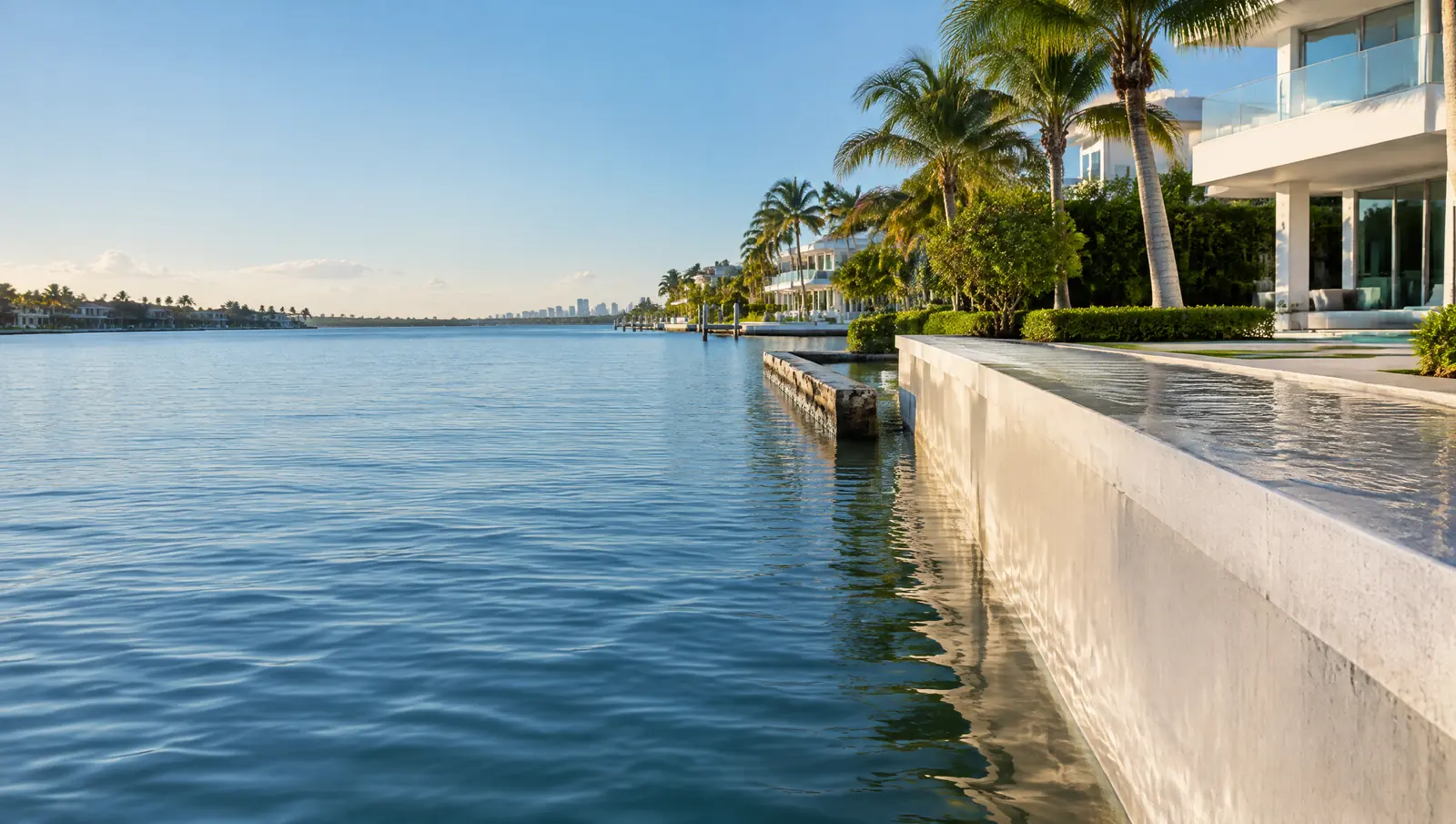
Seawall raising in Miami
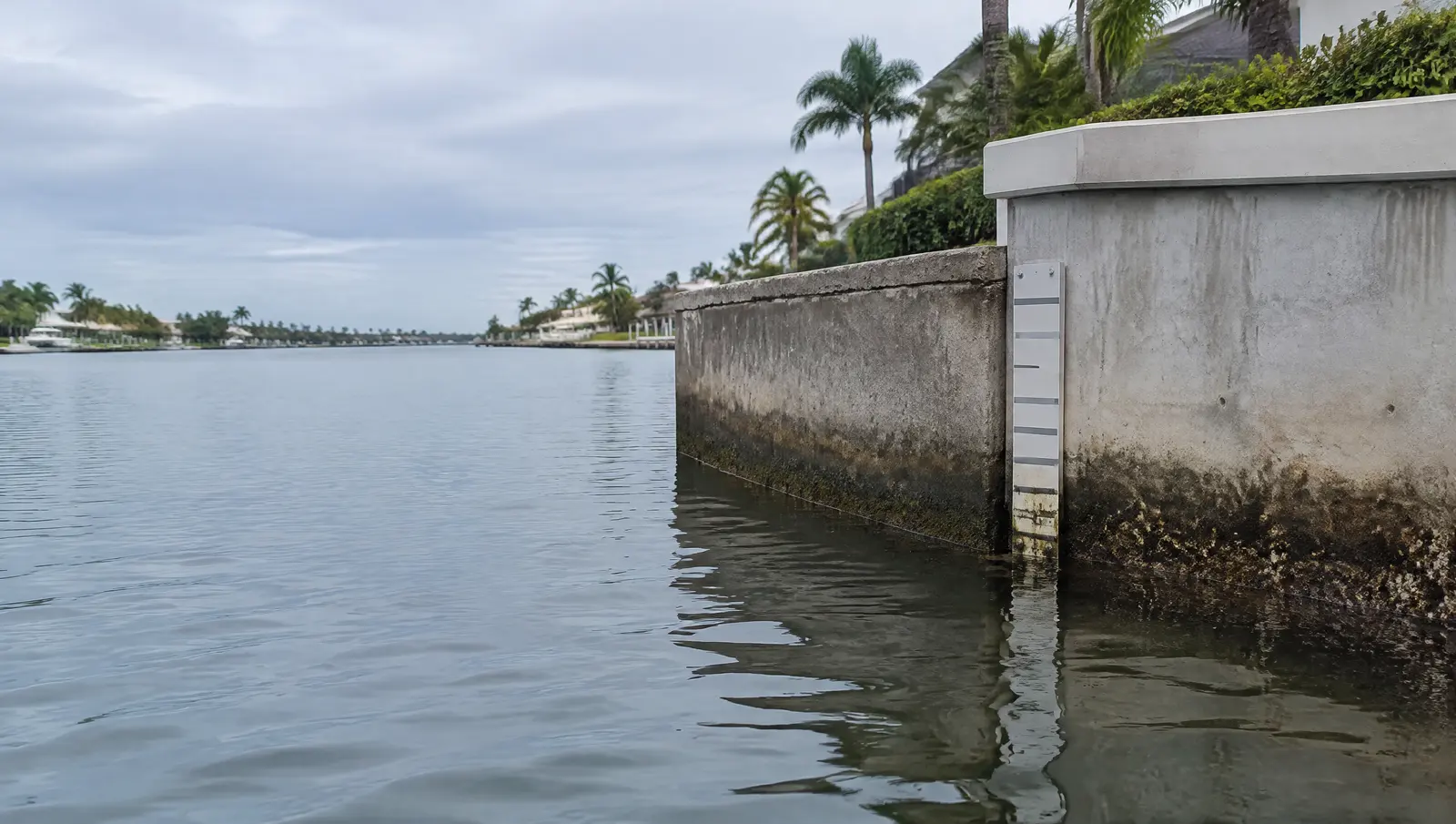
Seawall raising in Miami, where wall heights differ either side of the Rickenbacker Causeway.
Free Fast Quote
Please fill out this form to request a free quote on your upcoming project and we will respond to you right away!
Cities across South Florida now set minimum seawall heights. We work out which standard applies to your lot and whether a new cap or a new wall gets you there.
- Free, no-obligation quote
- Fast response from our team
- Miami-Dade, Broward, Palm Beach and the Keys
The short answer
City of Miami seawall tops have been set at +5.00 ft NGVD north of the Rickenbacker Causeway and +6.00 ft NGVD south of it, and a 2020 proposal would raise walls east of US-1 to 6 ft NAVD 88. The City of Miami is a Class 6 community in FEMA's Community Rating System, worth 20% off most flood policies since October 2022.
Last updated
Who needs a seawall raised
Owners whose walls overtop at king tides, owners who have been cited, and owners planning a repair big enough to trigger the city's height rule.
- Water over the cap at high tide
- A city citation for overtopping
- A repair of $300 or more per linear foot in Miami Beach
- Plans to sell, rebuild or add a dock
Typical project sizes
Raising is either a new cap on a sound wall or a full new wall. Miami Beach's 2017 rule of thumb was $1,000 to $1,500 per linear foot to bring an old seawall up to code.
Two seawall heights split by the Rickenbacker Causeway
The City code text that File 7338 set out to replace puts seawall tops at +5.00 ft NGVD north of the Rickenbacker Causeway and +6.00 ft NGVD south of it, so the same job can have a different minimum depending on which side of the causeway the lot sits. The 2020 proposal would have moved every wall east of US-1 to 6 ft NAVD 88, with the Miami River left to its own section of the code.
A raise is designed to that number, measured in the right datum, and checked by survey before the cap pour.[1]
Miami's flood insurance class
FEMA moved the City of Miami to Class 6 in the Community Rating System in May 2022, worth a 20% discount on most flood insurance policies issued or renewed from 1 October 2022. Flood barriers and vents do not change the city's class, but they protect the building that the policy covers.
Raising the wall stops tidal overtopping, but the home behind it still relies on its own flood protection.[2]
The tide at the Miamarina gauge
NOAA's Miami Miamarina station on Biscayne Bay records a mean tidal range of 2.17 ft and a great diurnal range of 2.37 ft, with mean higher high water about 0.26 ft above NAVD 88 (1983 to 2001 tidal epoch). Those numbers set how far a lift has to travel, how far a floating dock rises and falls, and how much freeboard a seawall cap really has.
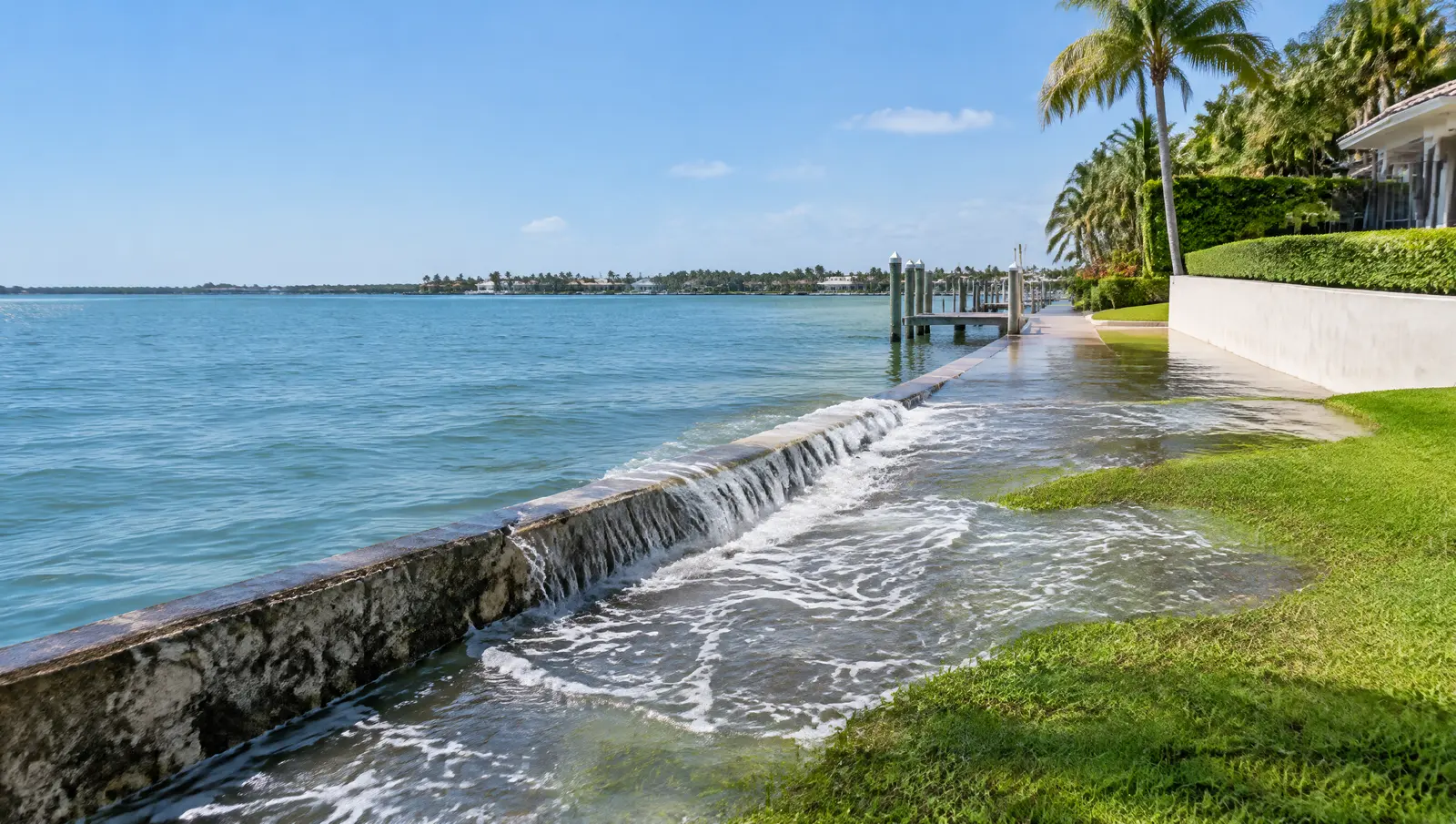
Those numbers show how much margin a raised wall really gives above an ordinary high tide.[3]
What makes Miami waterfront work different
Most of Biscayne Bay and its natural tributaries, including the Miami River and Little River, are state-owned submerged lands, so docks over them need the state's consent alongside the DERM permit. The Biscayne Bay Aquatic Preserve is listed by DERM as a permitting contact, and FDEP's free online dock self-certification is not available in aquatic preserves. The federal seagrass range used in dock design reaches central Biscayne Bay.[4][5][6]
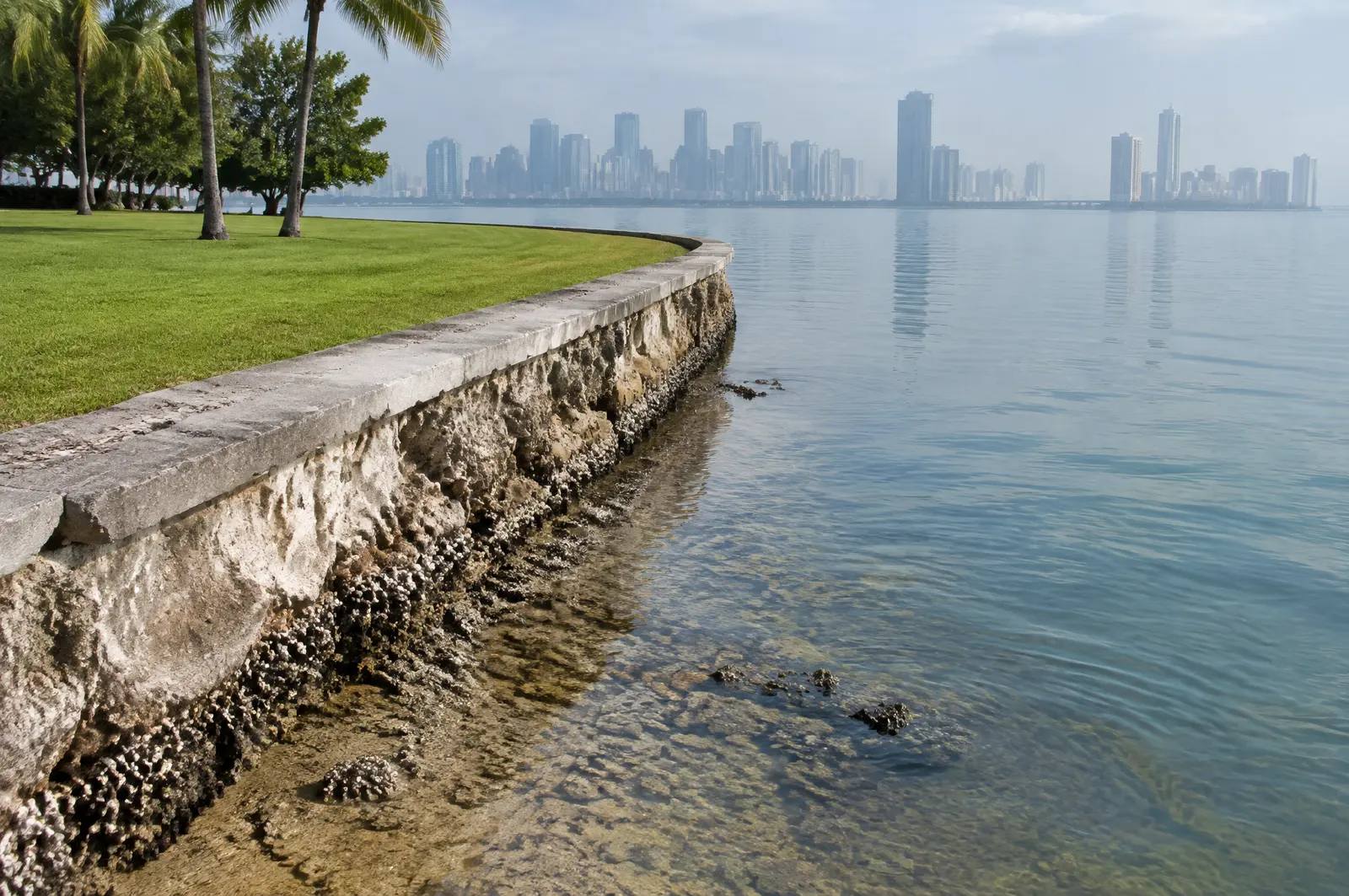
City of Miami seawall height
In 2020 the City considered an ordinance (File 7338) to set a 6 ft NAVD 88 minimum for new and rebuilt seawalls east of US-1, outside the Miami River. We have not confirmed that it was adopted, so for every Miami seawall job we confirm the current height rule with the City before design.[1]
Permits in Miami
- Miami-Dade DERM, Coastal Resources Section: Class I permit for any work in, on or over tidal water, the Miami River included, with exempt, expedited and short-form routes for small jobs. Phone (305) 372-6575.
- City of Miami Building Department: Structural and zoning approval for seawalls, docks and lifts inside city limits.
- Florida DEP or South Florida Water Management District: State permit or exemption, and consent to use the state-owned bottom of Biscayne Bay, the Miami River and Little River, which DERM grants for most of the bay on the state's behalf.
- US Army Corps of Engineers, Jacksonville District: Federal sign-off for work in the bay and the river. SPGP VI, the small-project route, passed its stated 27 July 2026 expiry, so we confirm the current route for each job.
Seawall height rules by city
Each city sets its own standard, and they do not all use the same vertical datum (NAVD 88 or the older NGVD 1929), so the engineer's survey must state the wall height in the same datum as your city's rule.
Miami Beach: 5.7 ft NAVD for new walls and substantial repairs, or 4 ft NAVD designed to reach 5.7 ft. Coral Gables: a minimum of 6 ft NGVD 1929, structurally able to support 7.5 ft. Fort Lauderdale: a minimum of 5 ft NAVD88, and walls permitted before 1 January 2035 may be built at 4 ft if designed to reach 5 ft by 1 January 2050. Boca Raton: new or replaced walls between 4.0 and 6.0 ft NAVD88, designed to take another 12 to 18 inches.
City of Miami: a 2020 proposal set 6 ft NAVD 88 east of US-1. We have not confirmed it was adopted, so we check with the City for each job.[9][12][14][15][1]
Help with the cost
Miami Beach's Private Property Adaptation program accepts seawall applications on a rolling basis and reimburses 50% of costs up to $20,000, including the $2,500 assessment value; qualifying low to moderate income households need no match up to $17,500. Homes built at least 1 ft above base flood elevation are not eligible. Coral Gables waives a fee for existing homes raising seawalls for sea level rise.[10][13]
| City | Standard or incentive | Source |
|---|---|---|
| Miami Beach | 5.7 ft NAVD (or 4 ft designed for 5.7 ft) | City FAQ, June 2025 |
| Miami Beach | Grant: 50% of costs up to $20,000 | PPA program page |
| Coral Gables | Minimum 6 ft NGVD 1929, supports 7.5 ft | City Attorney opinion, 2022 |
| Coral Gables | Fee waiver for raising existing residential seawalls | City permits page |
| Fort Lauderdale | Minimum 5 ft NAVD88 | City staff report, 2022 |
| Boca Raton | 4.0 to 6.0 ft NAVD88 | Engineering Design Standards, 2025 |
Frequently asked questions
How high does a seawall have to be in the City of Miami?
The code text File 7338 set out to replace uses +5.00 ft NGVD north of the Rickenbacker Causeway and +6.00 ft NGVD south of it. A 2020 proposal for 6 ft NAVD 88 east of US-1 was never confirmed as adopted, so we check the current rule with the City before design.
What flood insurance discount do Miami homeowners get?
FEMA set the City of Miami at Community Rating System Class 6, a 20% discount on most NFIP policies issued or renewed on or after 1 October 2022.
How much does the tide move in Miami?
At NOAA's Miami Miamarina gauge on Biscayne Bay the mean range is 2.17 ft and the great diurnal range 2.37 ft (1983 to 2001 epoch). King tides and storm surge go higher.
Sources
- City of Miami File ID 7338 (Revision A): Ordinance amending Chapters 20, 29 and 54 to set seawall minimum heights (Second Reading, printed 5/19/2020), City of Miami. Accessed October 27, 2026.
- Letter to the Miami City Manager on Community Rating System verification (12 May 2022), with CRS verification report, FEMA, Federal Insurance and Mitigation Administration (hosted by the City of Miami). Accessed October 28, 2026.
- Datums for station 8723165, Miami, Miamarina, Biscayne Bay (tidal epoch 1983 to 2001), NOAA Center for Operational Oceanographic Products and Services (CO-OPS), Tides and Currents. Accessed October 28, 2026.
- Class I Permit Application for Coastal Construction and Mangrove Trimming within Miami-Dade County (Revised May 2025), Miami-Dade County RER, Division of Environmental Resources Management (DERM), Coastal Resources Section. Accessed October 27, 2026.
- Dock Permitting in Florida: Permit Application Fee Schedule and Aquatic Preserve Design Criteria, Florida Department of Environmental Protection (FDEP). Accessed October 27, 2026.
- Department of the Army State Programmatic General Permit VI (SPGP VI), SAJ-2015-2575, State of Florida, U.S. Army Corps of Engineers, Jacksonville District (document hosted by Florida DEP). Accessed October 27, 2026.
- Biscayne Bay Aquatic Preserve, Florida Department of Environmental Protection, Office of Resilience and Coastal Protection. Accessed October 28, 2026.
- Florida Statutes 2026, Section 403.813: Permits issued at district centers; exceptions, The Florida Legislature (Online Sunshine). Accessed October 27, 2026.
- Seawall FAQs (Miami Beach Rising Above, PDF dated 6.16.25), City of Miami Beach. Accessed October 27, 2026.
- Private Property Adaptation (PPA) program, City of Miami Beach (Miami Beach Rising Above). Accessed October 27, 2026.
- Rising Above the Risk: Frequently Asked Questions (05/05/2017), City of Miami Beach. Accessed October 27, 2026.
- CAO 2022-007: Legal Opinion Regarding Scrivener's Error in Zoning Code 3-706 Bulkheads and Retaining Walls (17 Aug 2022), City of Coral Gables, City Attorney. Accessed October 27, 2026.
- Solar, Open Air Dining, and Other Permits, City of Coral Gables. Accessed October 27, 2026.
- Staff Report, Planning and Zoning Board, 16 Nov 2022, Case UDP-T22010 (Tidal barrier / seawall ordinance amendment, ULDR 47-19.3), City of Fort Lauderdale. Accessed October 27, 2026.
- Engineering Design Standards Manual, section 7.7 Minimum Criteria for Waterway Features (PDF modified 10 Apr 2025), City of Boca Raton. Accessed October 28, 2026.
Get a free quote
Tell us about your project and we will get back to you fast.