
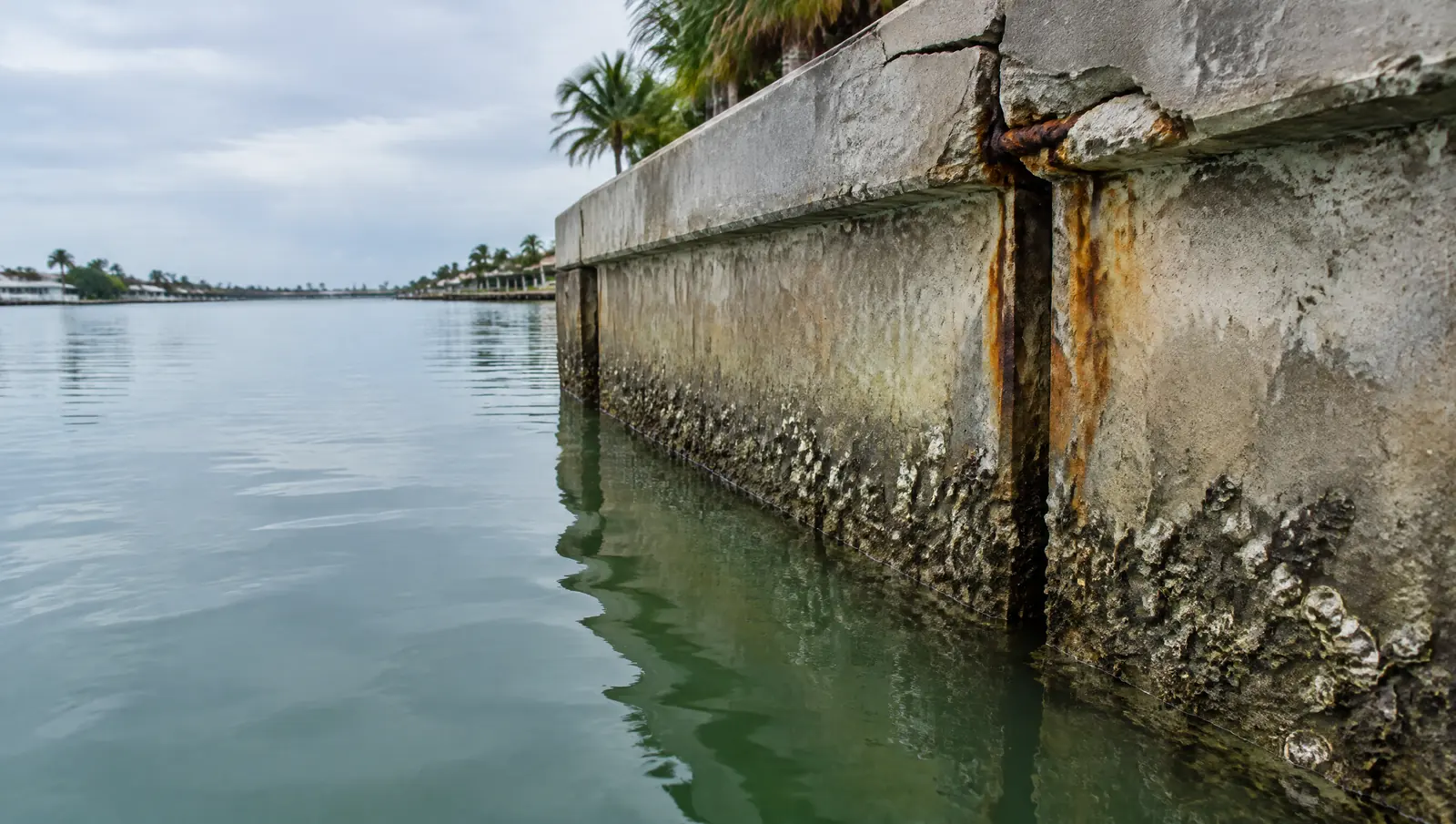
Seawall repair in Miami
Cracked cap or leaking joint in Miami? Get it repaired properly.
Free Fast Quote
Please fill out this form to request a free quote on your upcoming project and we will respond to you right away!
We seal cracks and leaking panel joints, rebuild spalled caps, replace tiebacks and backfill washed-out soil, then tell you honestly whether repair still makes sense or the wall needs replacing.
- Free, no-obligation quote
- Fast response from our team
- Miami-Dade, Broward, Palm Beach and the Keys
The short answer
Most small seawall repairs in Miami, including sealing cracks, spall repair on the cap or face and backfilling behind the wall, need no DERM Class I permit; cap and tieback replacement need an expedited authorisation with a $75 DERM review fee (Miami-Dade DERM, 2025). Rebuilding the wall moves it to a short-form permit.
Last updated
Signs you need seawall repair
Call us when you see any of these. Each one lets water and soil move through the wall, and the damage speeds up once it starts.
- Cracks, spalling or rust stains on the cap or face
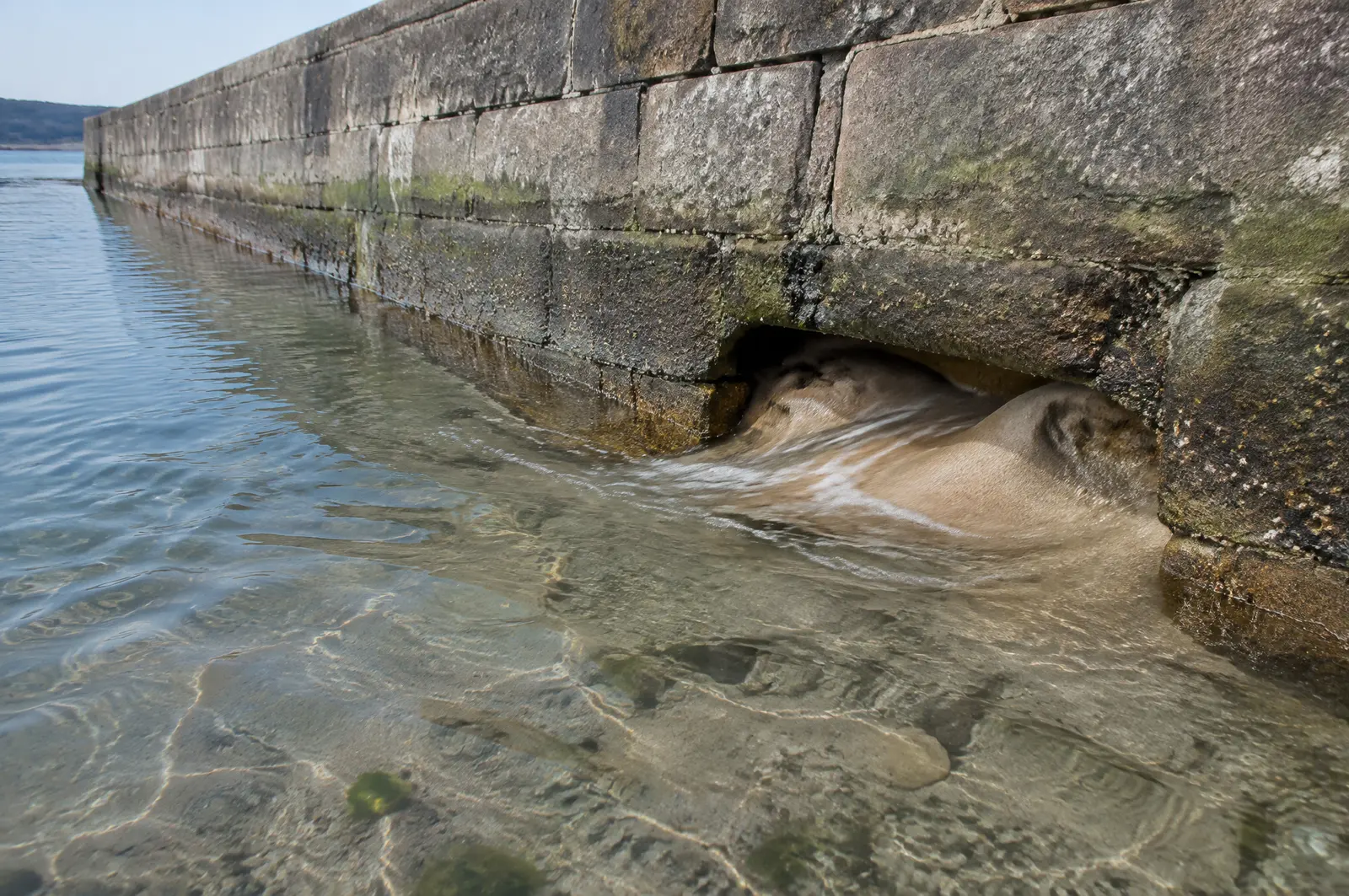
- Open or leaking joints between panels
- Sinkholes or soft ground just behind the wall
- Water seeping through the wall at high tide
- A cap or panels leaning toward the water
Typical project sizes
Repairs range from a few feet of crack sealing to rebuilding tiebacks along a whole lot. In Miami Beach a repair costing $300 or more per linear foot counts as substantial and must bring the wall up to 5.7 ft NAVD, so the size of a repair can change what the city requires.
Exempt, expedited or short form?
Exempt: crack sealing and spall repair on the cap or face, pilaster repair, backfilling, riprap or sand-cement bags at the toe no more than 2 ft waterward. Expedited: cap or tieback repair and replacement with structurally approved plans. Short form: rebuilding or replacing the wall at the mean high water line or up to 18 inches waterward.[1]
Repairs along the Miami River and the bay
Under DERM's rules, a contractor replacing fender or mooring piles in the same spot must hold a certificate of competency and give DERM 24 hours' notice. Where repairs disturb the bottom, the seagrass range that reaches central Biscayne Bay can bring a survey requirement.[1][2]
What would count as a substantial repair
The 2020 Miami proposal defined a substantial seawall repair three ways: work on 50% or more of the barrier length, work costing 50% or more of a new wall, or a change in elevation along 50% or more of the length. It also asked for new walls that can be raised to at least 8 ft NAVD 88 later, with a variance route for undue hardship.
Before we price a repair we check whether its cost or extent would trigger the full height rule.[3]
Two seawall heights split by the Rickenbacker Causeway
The City code text that File 7338 set out to replace puts seawall tops at +5.00 ft NGVD north of the Rickenbacker Causeway and +6.00 ft NGVD south of it, so the same job can have a different minimum depending on which side of the causeway the lot sits. The 2020 proposal would have moved every wall east of US-1 to 6 ft NAVD 88, with the Miami River left to its own section of the code.
A repair that leaves the cap below that height can be the right call, as long as you know a raise may come later.[3]
The tide at the Miamarina gauge
NOAA's Miami Miamarina station on Biscayne Bay records a mean tidal range of 2.17 ft and a great diurnal range of 2.37 ft, with mean higher high water about 0.26 ft above NAVD 88 (1983 to 2001 tidal epoch). Those numbers set how far a lift has to travel, how far a floating dock rises and falls, and how much freeboard a seawall cap really has.
Repairs low on the wall face are timed to the lowest tides of the month.[4]
What makes Miami waterfront work different
Most of Biscayne Bay and its natural tributaries, including the Miami River and Little River, are state-owned submerged lands, so docks over them need the state's consent alongside the DERM permit. The Biscayne Bay Aquatic Preserve is listed by DERM as a permitting contact, and FDEP's free online dock self-certification is not available in aquatic preserves. The federal seagrass range used in dock design reaches central Biscayne Bay.[1][5][2]
City of Miami seawall height
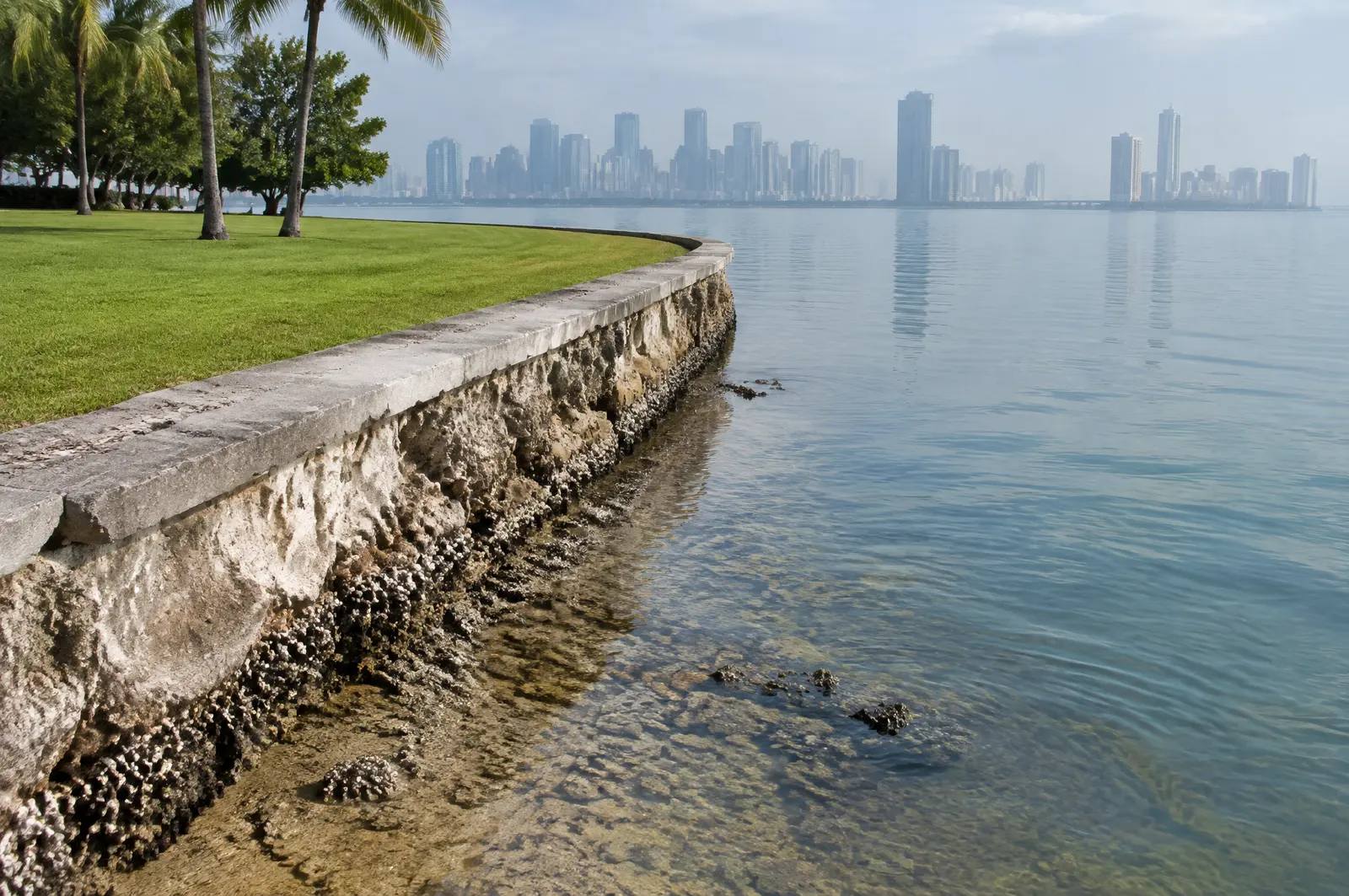
In 2020 the City considered an ordinance (File 7338) to set a 6 ft NAVD 88 minimum for new and rebuilt seawalls east of US-1, outside the Miami River. We have not confirmed that it was adopted, so for every Miami seawall job we confirm the current height rule with the City before design.[3]
Permits in Miami
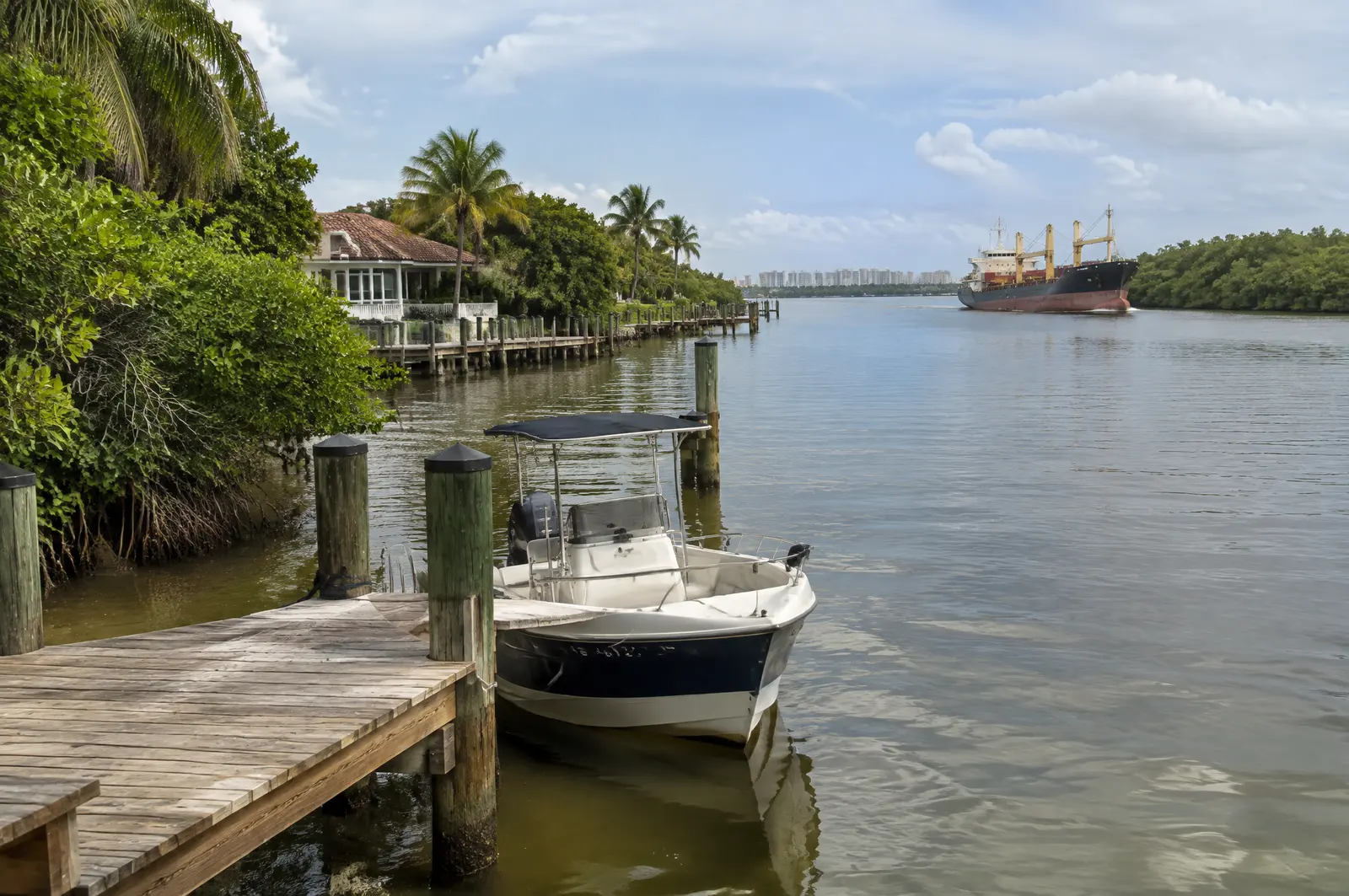
- Miami-Dade DERM, Coastal Resources Section: Class I permit for any work in, on or over tidal water, the Miami River included, with exempt, expedited and short-form routes for small jobs. Phone (305) 372-6575.
- City of Miami Building Department: Structural and zoning approval for seawalls, docks and lifts inside city limits.
- Florida DEP or South Florida Water Management District: State permit or exemption, and consent to use the state-owned bottom of Biscayne Bay, the Miami River and Little River, which DERM grants for most of the bay on the state's behalf.
- US Army Corps of Engineers, Jacksonville District: Federal sign-off for work in the bay and the river. SPGP VI, the small-project route, passed its stated 27 July 2026 expiry, so we confirm the current route for each job.
How do you repair a seawall?
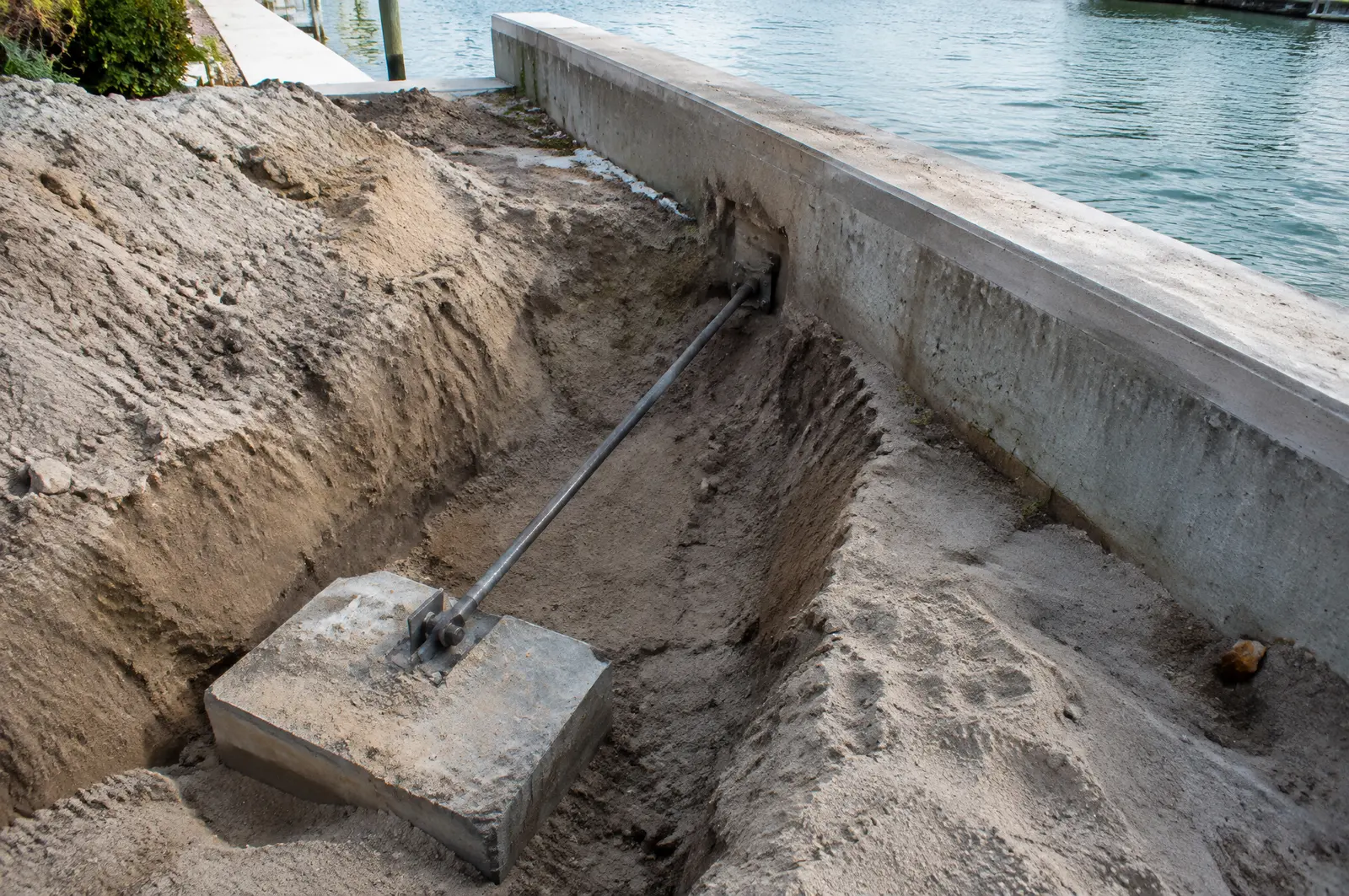
We start with a close inspection at low tide to find where water and soil are moving. Then the fix matches the fault: crack injection or patching for the face, rebuilt concrete for spalled caps, new tie rods and anchors where the wall is leaning, and compacted fill behind the wall once it is sealed.
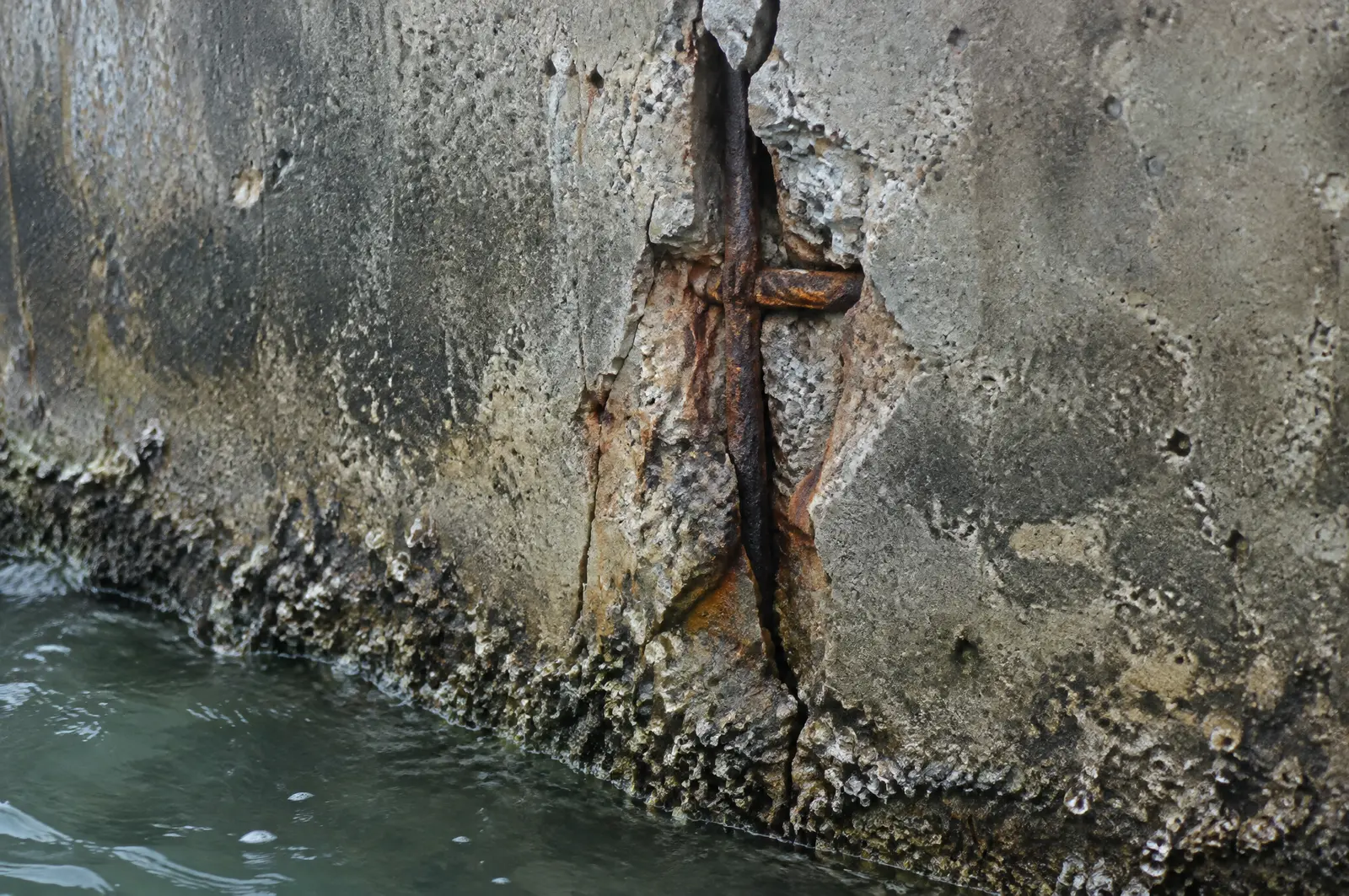
- Inspect the cap, face, joints and toe at low tide
- Confirm the permit path (exempt, expedited or short form)
- Seal joints and cracks, repair spalls
- Replace tiebacks or the cap if needed
- Backfill and restore the yard
Which seawall repairs need a permit?
Miami-Dade DERM lists as exempt: sealing cracks and spall repair on the cap or face, repair or sealing of pilasters, backfilling landward of an existing seawall, riprap or gunite tubes under an undercut wall no more than 2 ft waterward, and sand-cement bags at the toe no more than 2 ft waterward. Cap and tieback repair or replacement need structurally approved plans from the building department and an expedited DERM authorisation. Your city may still need a building permit.[1]
Repair or replace?
If the panels are sound and the wall is tall enough for local rules, repair is usually the better value. If repairs would cross a city's substantial repair line, such as $300 per linear foot in Miami Beach, you may have to raise the whole wall anyway, and replacement can make more sense.[9]
| Item | Figure | Source year |
|---|---|---|
| Cap spall repair | $60 per cubic foot of epoxy mortar | 2016 (Fort Lauderdale) |
| Adding a 12-inch cap to an existing wall | $75 to $125 per linear foot | 2016 (Fort Lauderdale) |
| DERM expedited review, seawall cap replacement | $75 | 2025 (Miami-Dade) |
| DERM expedited review, tie rod replacement | $75 | 2025 (Miami-Dade) |
| Miami Beach substantial repair threshold | $300 or more per linear foot | 2025 (Miami Beach) |
Frequently asked questions
How fast can a seawall repair start in Miami?
Exempt repairs can start once the City confirms its own requirements. Cap or tieback work waits for structurally approved plans and DERM's expedited authorisation.
Will a repair force me to raise my Miami seawall?
Possibly, if the City's substantial repair rule applies. A 2020 proposal used 50% of length or cost as the test; we confirm the rule in force before pricing.
Sources
- Class I Permit Application for Coastal Construction and Mangrove Trimming within Miami-Dade County (Revised May 2025), Miami-Dade County RER, Division of Environmental Resources Management (DERM), Coastal Resources Section. Accessed October 27, 2026.
- Department of the Army State Programmatic General Permit VI (SPGP VI), SAJ-2015-2575, State of Florida, U.S. Army Corps of Engineers, Jacksonville District (document hosted by Florida DEP). Accessed October 27, 2026.
- City of Miami File ID 7338 (Revision A): Ordinance amending Chapters 20, 29 and 54 to set seawall minimum heights (Second Reading, printed 5/19/2020), City of Miami. Accessed October 27, 2026.
- Datums for station 8723165, Miami, Miamarina, Biscayne Bay (tidal epoch 1983 to 2001), NOAA Center for Operational Oceanographic Products and Services (CO-OPS), Tides and Currents. Accessed October 28, 2026.
- Dock Permitting in Florida: Permit Application Fee Schedule and Aquatic Preserve Design Criteria, Florida Department of Environmental Protection (FDEP). Accessed October 27, 2026.
- Biscayne Bay Aquatic Preserve, Florida Department of Environmental Protection, Office of Resilience and Coastal Protection. Accessed October 28, 2026.
- Florida Statutes 2026, Section 403.813: Permits issued at district centers; exceptions, The Florida Legislature (Online Sunshine). Accessed October 27, 2026.
- Letter to the Miami City Manager on Community Rating System verification (12 May 2022), with CRS verification report, FEMA, Federal Insurance and Mitigation Administration (hosted by the City of Miami). Accessed October 28, 2026.
- Seawall FAQs (Miami Beach Rising Above, PDF dated 6.16.25), City of Miami Beach. Accessed October 27, 2026.
- Seawalls and Sea Level Rise Induced Flooding (Florida Sea Grant compilation, includes City of Fort Lauderdale 'Frequently Asked Questions: Seawall Ordinance Implementation', 25 Jan 2017), Florida Sea Grant (reproducing City of Fort Lauderdale and Florida Bar ELULS material). Accessed October 27, 2026.
Get a free quote
Tell us about your project and we will get back to you fast.