
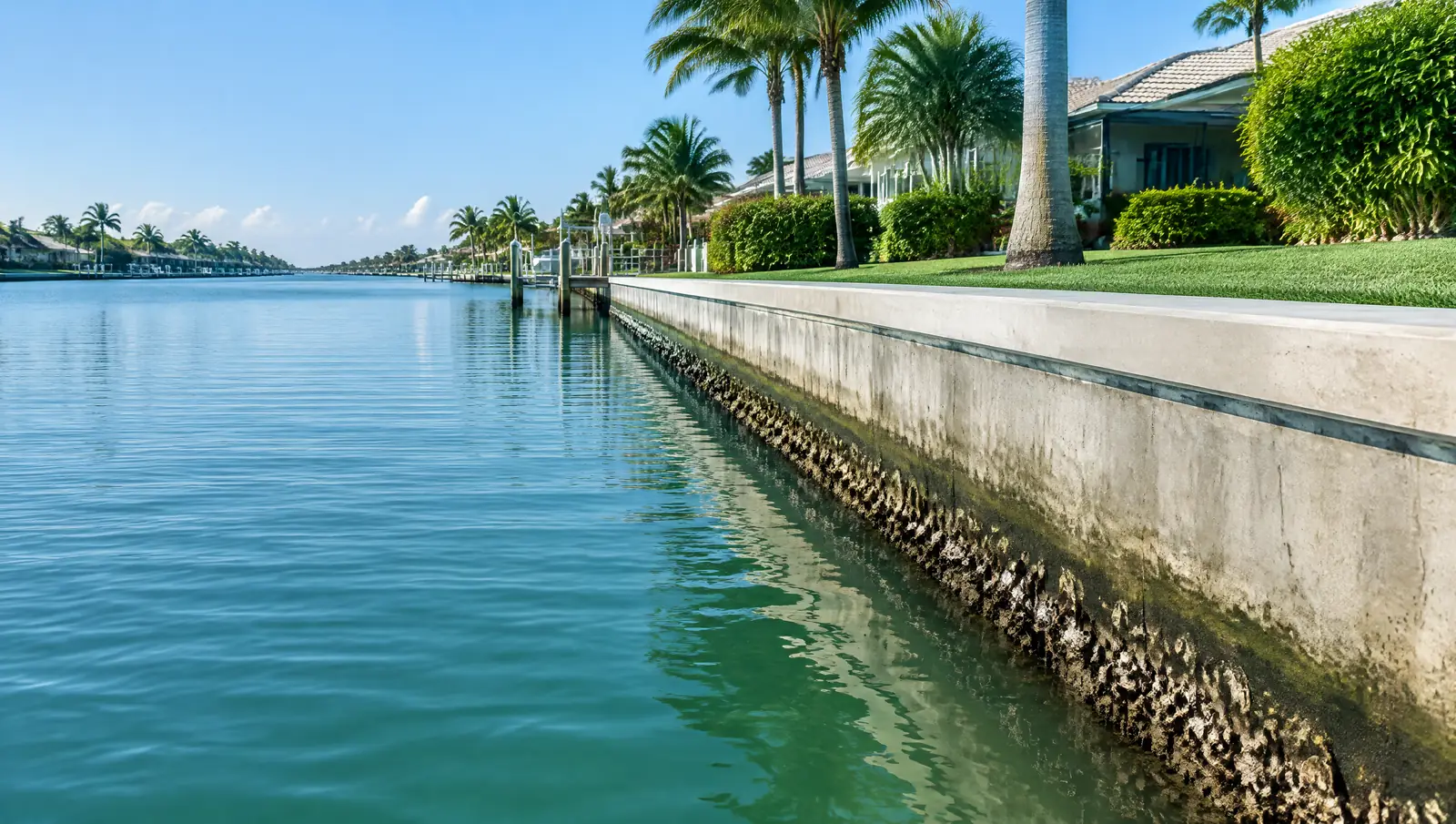
Seawalls in Miami Beach
Seawall raising and repair to Miami Beach's 5.7 ft NAVD rule.
Free Fast Quote
Please fill out this form to request a free quote on your upcoming project and we will respond to you right away!
We repair cracked caps and leaking joints, replace failing walls, raise seawalls to new city heights and protect the toe with riprap, across Miami-Dade, Broward, Palm Beach and the Keys.
- Free, no-obligation quote
- Fast response from our team
- Miami-Dade, Broward, Palm Beach and the Keys
The short answer
Every new seawall in Miami Beach, and every repair costing $300 or more per linear foot, must reach 5.7 ft NAVD or be built to 4 ft NAVD and designed for 5.7 ft (City of Miami Beach, 2025). The city's PPA grant reimburses 50% of eligible costs up to $20,000.
Last updated
Typical project sizes
Most residential lots have 50 to 150 feet of waterfront, so a full replacement is usually a five or six figure project, while cap, crack and tieback repairs are much smaller. Fort Lauderdale's 2016 survey priced engineering and permitting alone at $2,000 to $5,000 per job.
Rules that set the job
Miami Beach requires owners whose walls let tidal water flow over or through them to correct it, either by raising the wall or adding a retaining wall, and can cite owners with no seawall at all. A permit needs a City building permit with a site plan, structural plans and an elevation certification, plus DERM Coastal Resources approval.[1]
Costs in Miami Beach
The city's 2017 rule of thumb was $1,000 to $1,500 per linear foot to bring an old seawall up to code. The city's own public seawall program had cost $80.3 million as of October 2025.[4][3]
Tide at Government Cut
NOAA's Miami Harbor Entrance gauge at Government Cut, beside South Beach, shows a 2.46 ft mean range and a 2.70 ft great diurnal range, with mean higher high water about 0.33 ft above NAVD 88 (1983 to 2001 epoch). A wall at 5.7 ft NAVD therefore stands roughly 5.4 ft above an average high tide, the margin the City wants for king tides and sea level rise.
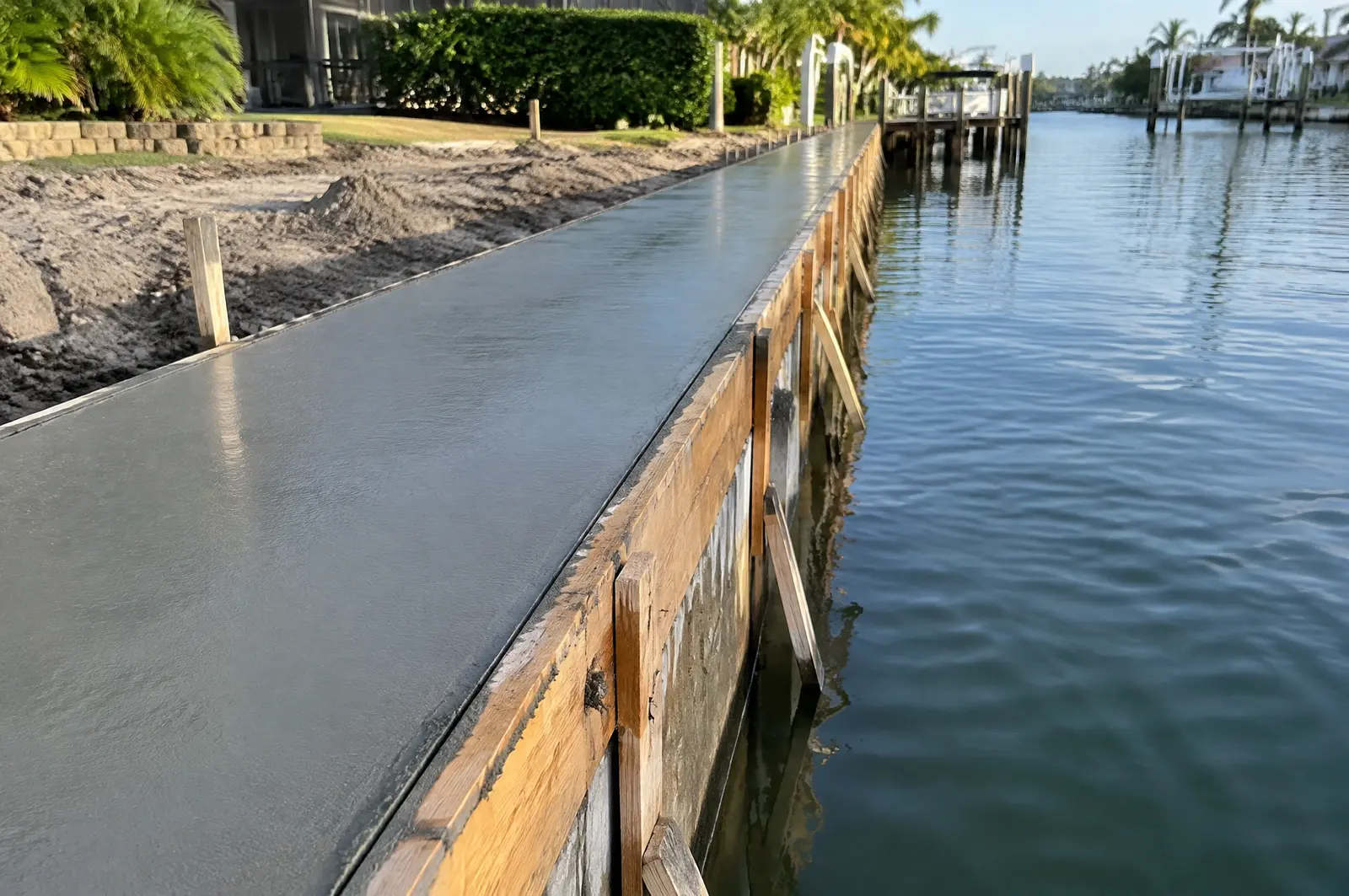
The tide also sets how much of the wall can be worked on dry at low water, which changes crew time.[5]
What makes Miami Beach different
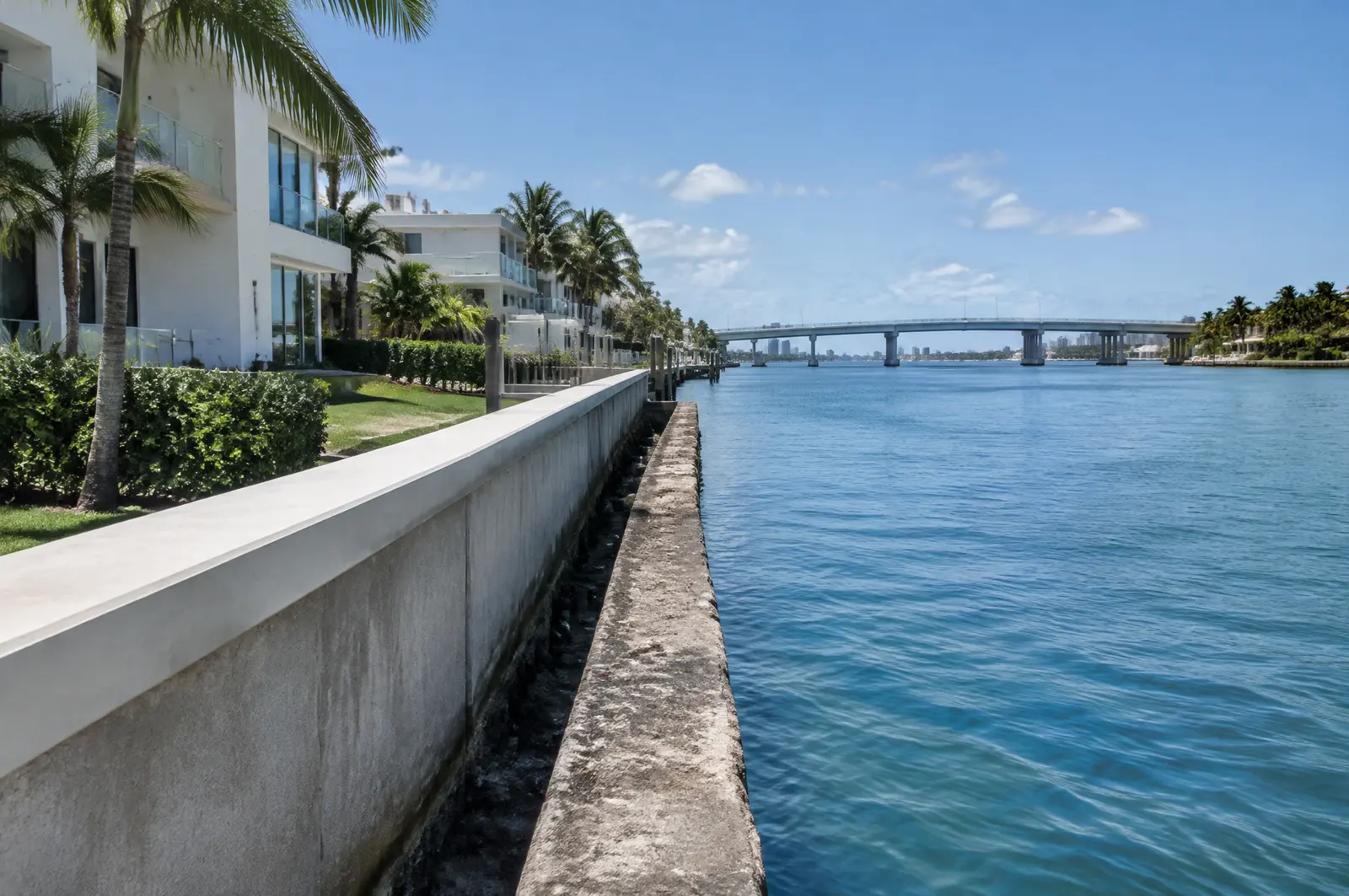
The city has about 55 miles of seawall, of which only about 5 miles are publicly owned, so most of it is the responsibility of private owners. Its seawall ordinance dates from Resolution R2016-4009 in May 2016, was strengthened in January 2021 and amended again in July 2025.[1][3]
Groundwater and flooding
The city notes that groundwater rises through the porous bedrock under Miami Beach, so a seawall alone cannot stop flooding. A raised wall stops tidal overtopping; drainage and flood protection handle the rest.[4]
Permits for seawalls in Miami Beach
- City of Miami Beach Building Department: Building permit with a site plan, structural plans and an elevation certification.
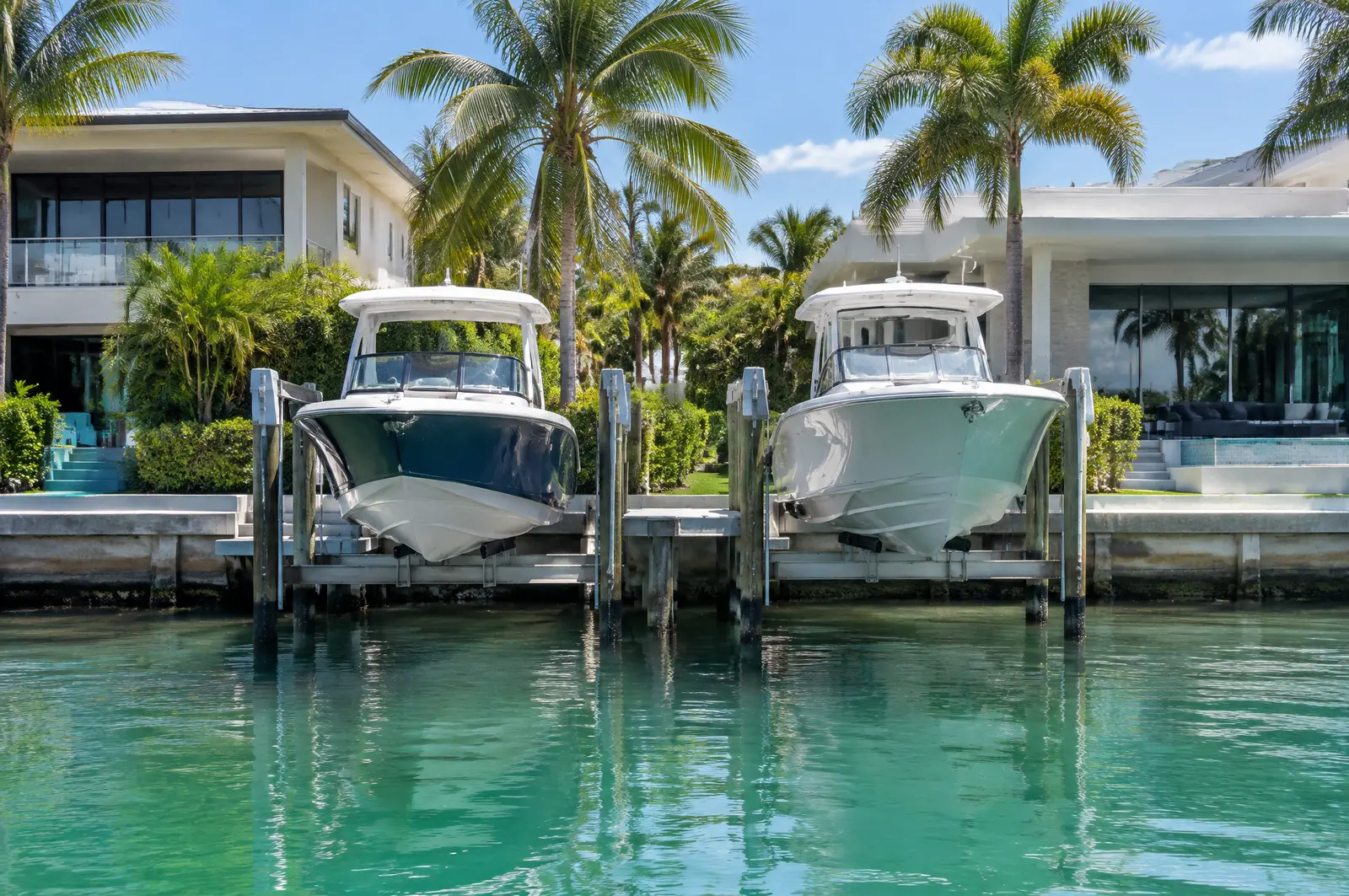
- Miami-Dade DERM, Coastal Resources Section: Class I permit or exemption for seawalls, docks and lifts on the island canals and the bay, issued alongside the City permit. Phone (305) 372-6575.
- Florida DEP or South Florida Water Management District: State review where a dock or wall reaches open Biscayne Bay, part of the aquatic preserve, where FDEP's free online self-certification is not available.
- US Army Corps of Engineers, Jacksonville District: Federal authorisation for work in Biscayne Bay and Indian Creek; we confirm the small-project route since SPGP VI's stated July 2026 expiry.
Which permits does seawall work need?
In Miami-Dade, any work in, on, over or upon tidal waters needs a DERM Class I permit under Section 24-48 of the County Code, including inside cities. Minor repairs are exempt, cap and tieback work gets an expedited authorisation, and rebuilding a wall at the mean high water line or up to 18 inches waterward is a short-form permit approved by staff.
The city building department also issues a structural permit. A state exemption does not remove county and city permits: Florida Statute 403.813 says its exemptions do not relieve anyone from county and municipal requirements, so in Miami-Dade a DERM Class I permit still applies.[6][8]
How long does a seawall last?
Fort Lauderdale's seawall ordinance FAQ assumed a design life of about 50 years, and city engineers described a 30 to 50 year lifespan for a wall built today. Salt water, wave action from boat wakes and rising tides shorten that when cracks and failed joints are left open.[9]
Why heights matter now
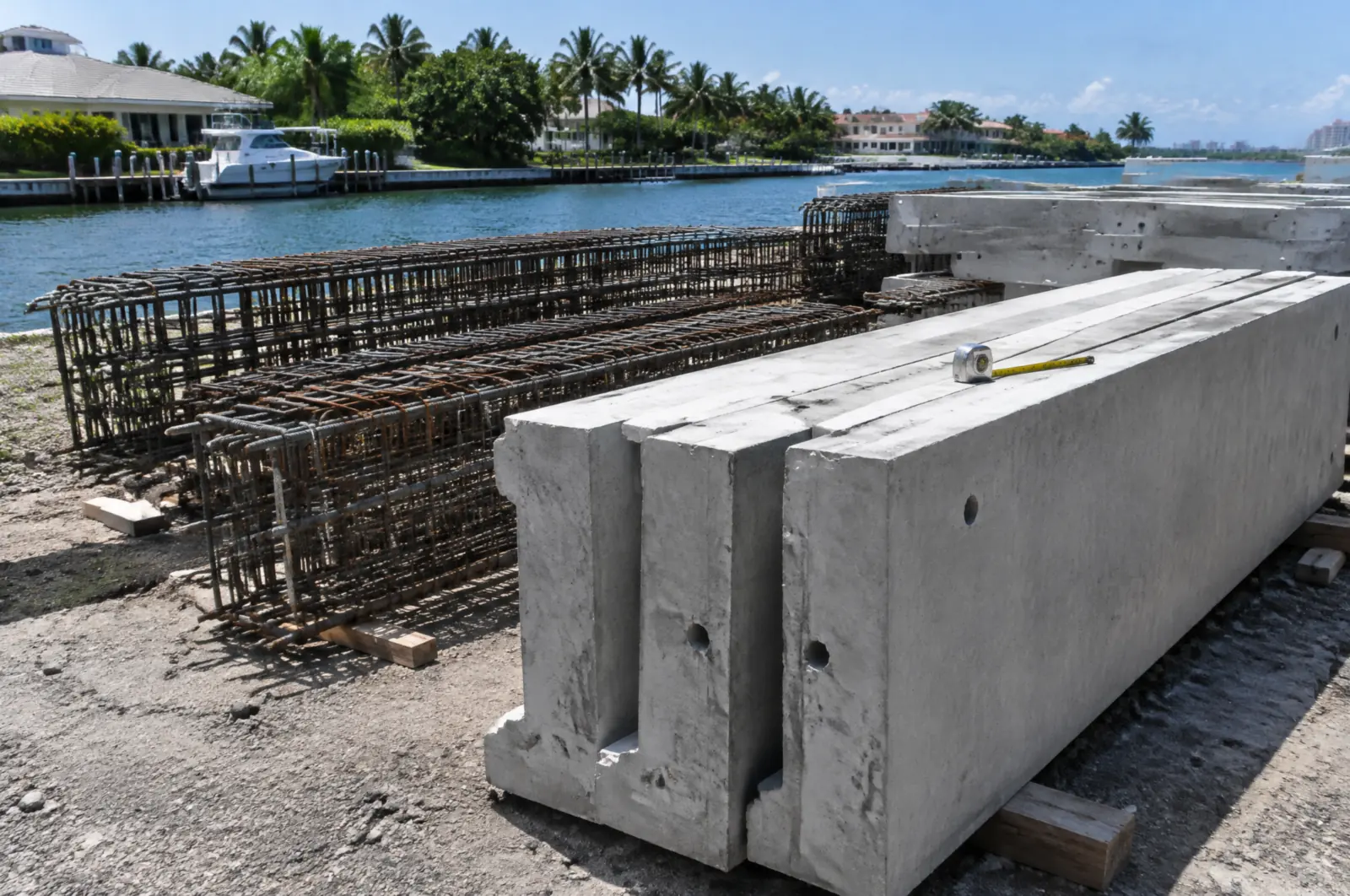
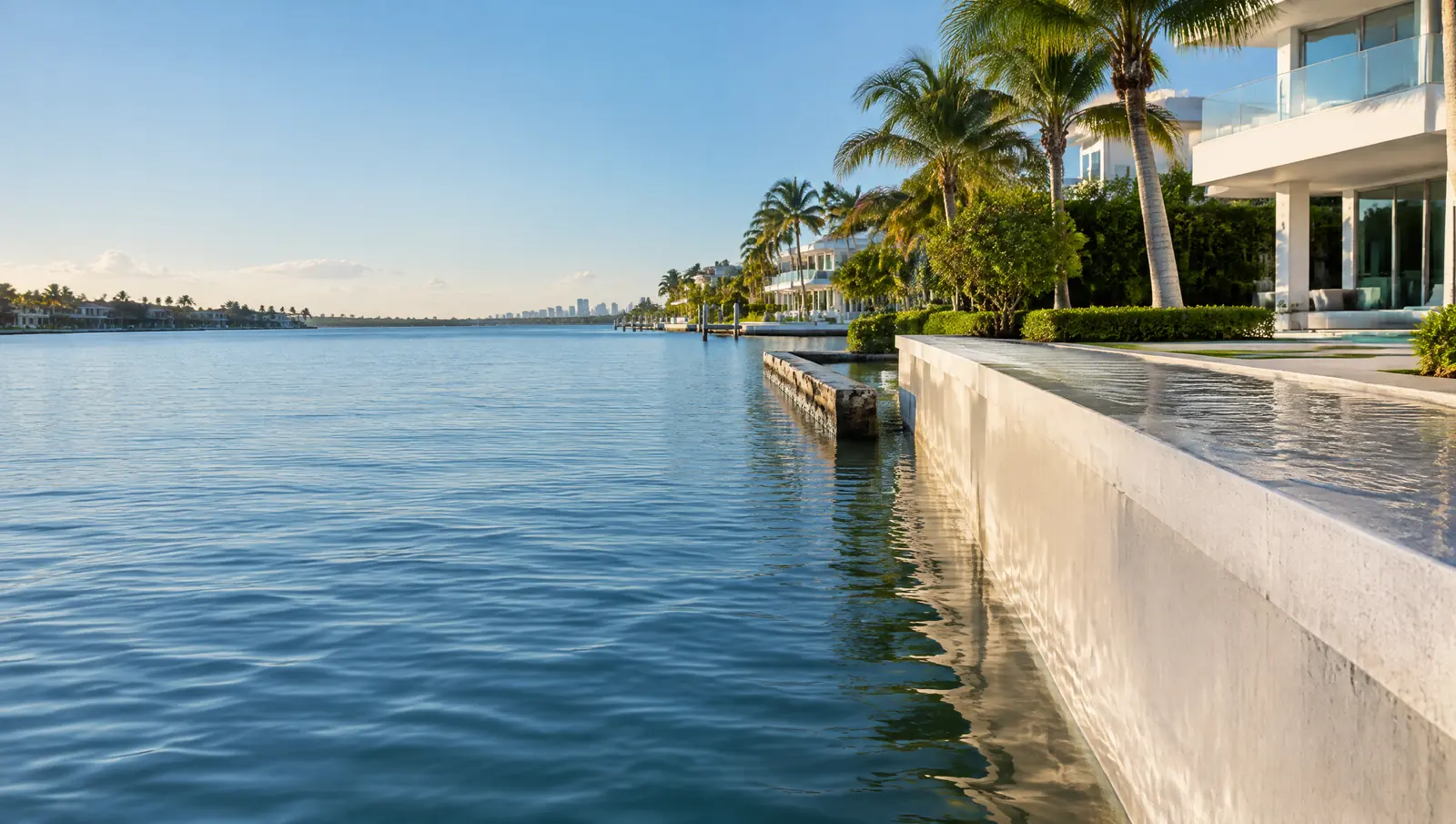
Cities are raising the bar. Miami Beach requires new and substantially repaired seawalls to reach 5.7 ft NAVD, Coral Gables sets bulkheads at a minimum of 6 ft NGVD 1929, and Fort Lauderdale requires 5 ft NAVD. A repair that triggers these rules can turn into a raising job, so we check the local standard before we price.[1][10][11]
| Item | Figure |
|---|---|
| Height standard | 5.7 ft NAVD, or 4 ft NAVD designed for 5.7 ft |
| Substantial repair | $300 or more per linear foot |
| After a citation | 60 days to show progress, 730 days to finish |
| Fines | $250 first offence, then $500 per day |
| PPA grant | 50% of costs up to $20,000 |
| Cost to bring an old wall to code (2017) | $1,000 to $1,500 per linear foot |
Seawalls services in Miami Beach
Seawall repair in Miami Beach
Crack and spall repair, joint sealing, tiebacks, pilasters and backfill.
Seawall replacement in Miami Beach
New concrete seawalls, usually built just in front of the failing wall.
Seawall caps in Miami Beach
New and replacement concrete caps, including caps that raise the wall.
Seawall raising in Miami Beach
Raising walls to Miami Beach, Coral Gables and other city height standards.
Riprap and toe protection in Miami Beach
Limerock boulders, gunite tubes and sand-cement bags at the base of the wall.
Seawall inspections in Miami Beach
Low-tide condition checks, including after a city notice or before a sale.
Frequently asked questions
What counts as a substantial seawall repair in Miami Beach?
Any repair or improvement costing $300 or more per linear foot. It must then meet the 5.7 ft NAVD standard.
How much does a seawall cost in Miami Beach?
The city's 2017 rule of thumb was $1,000 to $1,500 per linear foot to bring an old wall up to code. Prices have risen since, and the PPA grant can offset up to $20,000.
Sources
- Seawall FAQs (Miami Beach Rising Above, PDF dated 6.16.25), City of Miami Beach. Accessed October 27, 2026.
- Private Property Adaptation (PPA) program, City of Miami Beach (Miami Beach Rising Above). Accessed October 27, 2026.
- Seawalls (Public Infrastructure), City of Miami Beach (Miami Beach Rising Above). Accessed October 27, 2026.
- Rising Above the Risk: Frequently Asked Questions (05/05/2017), City of Miami Beach. Accessed October 27, 2026.
- Datums for station 8723170, Miami Harbor Entrance (tidal epoch 1983 to 2001), NOAA Center for Operational Oceanographic Products and Services (CO-OPS), Tides and Currents. Accessed October 28, 2026.
- Class I Permit Application for Coastal Construction and Mangrove Trimming within Miami-Dade County (Revised May 2025), Miami-Dade County RER, Division of Environmental Resources Management (DERM), Coastal Resources Section. Accessed October 27, 2026.
- Press release: Miami Beach Receives Improved Class 5 Rating from FEMA (3 April 2019), City of Miami Beach, Department of Marketing and Communications. Accessed October 28, 2026.
- Florida Statutes 2026, Section 403.813: Permits issued at district centers; exceptions, The Florida Legislature (Online Sunshine). Accessed October 27, 2026.
- Seawalls and Sea Level Rise Induced Flooding (Florida Sea Grant compilation, includes City of Fort Lauderdale 'Frequently Asked Questions: Seawall Ordinance Implementation', 25 Jan 2017), Florida Sea Grant (reproducing City of Fort Lauderdale and Florida Bar ELULS material). Accessed October 27, 2026.
- CAO 2022-007: Legal Opinion Regarding Scrivener's Error in Zoning Code 3-706 Bulkheads and Retaining Walls (17 Aug 2022), City of Coral Gables, City Attorney. Accessed October 27, 2026.
- Staff Report, Planning and Zoning Board, 16 Nov 2022, Case UDP-T22010 (Tidal barrier / seawall ordinance amendment, ULDR 47-19.3), City of Fort Lauderdale. Accessed October 27, 2026.
Get a free quote
Tell us about your project and we will get back to you fast.