
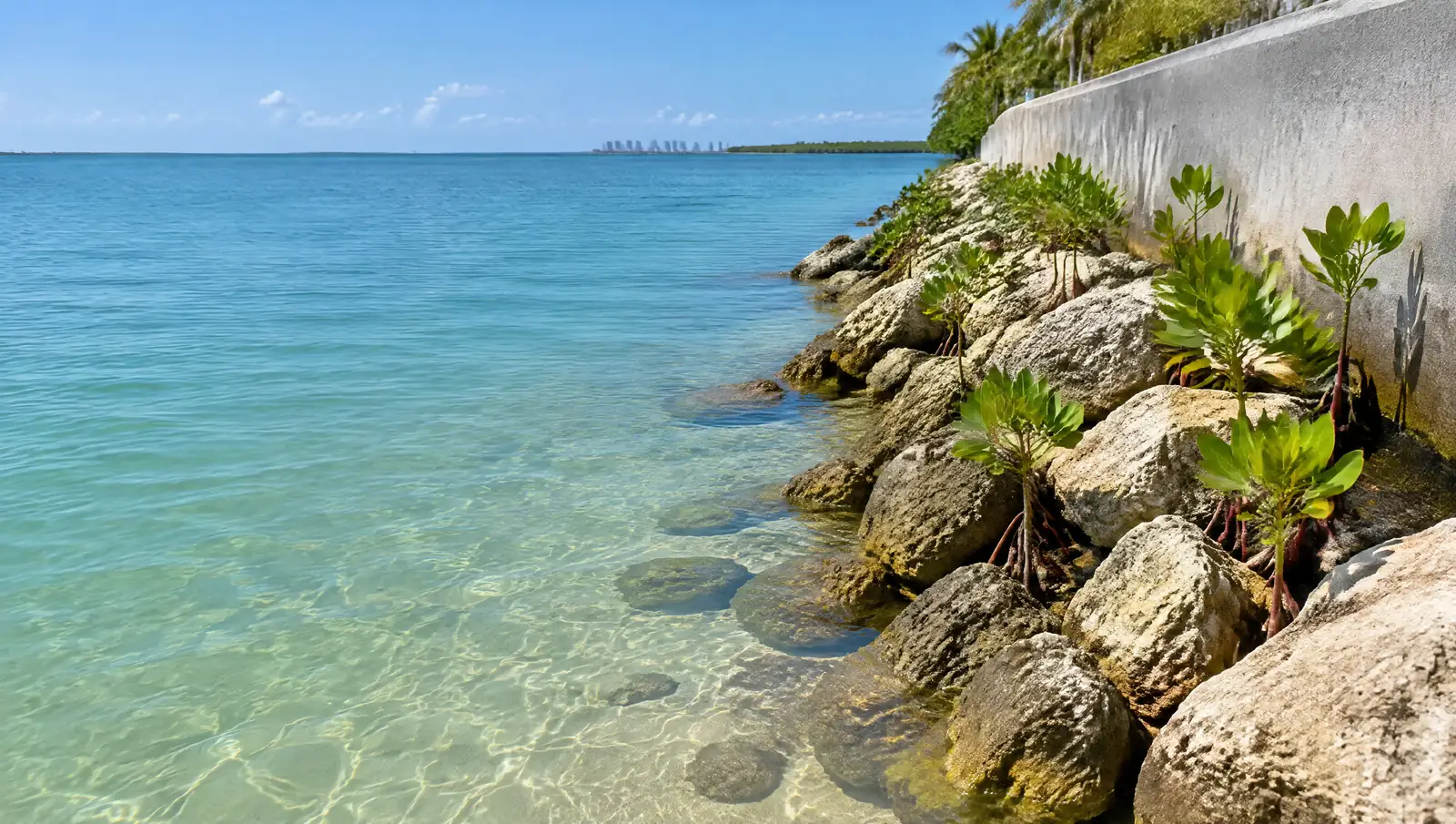
Riprap and toe protection in Key Largo
Riprap in Key Largo, placed at the toe of canal seawalls as Monroe County asks wherever feasible.
Free Fast Quote
Please fill out this form to request a free quote on your upcoming project and we will respond to you right away!
When water scours under the toe of a wall, the wall starts to tip. Riprap and toe repairs stop that, and some are permit-exempt in Miami-Dade.
- Free, no-obligation quote
- Fast response from our team
- Miami-Dade, Broward, Palm Beach and the Keys
The short answer
In Key Largo new vertical seawalls are allowed only on man-made canals and basins, while existing walls can be repaired or replaced on the same footprint. A Key Largo pier dock may be 4 ft wide and no longer than twice the shoreline frontage or 100 ft, unless a special exception is granted.
Last updated
Signs the toe needs work
Look for these at low tide.
- A gap or hollow under the base of the wall
- Wall tipping toward the water
- Soil loss behind the wall with no visible crack
- Strong wakes or currents along the lot
Typical project sizes
Toe repairs often cover the worst few sections of wall; riprap revetments usually run the full frontage. The state general permit covers up to 100 linear feet of riprap at a slope no steeper than 2:1.
Where a seawall is allowed at all
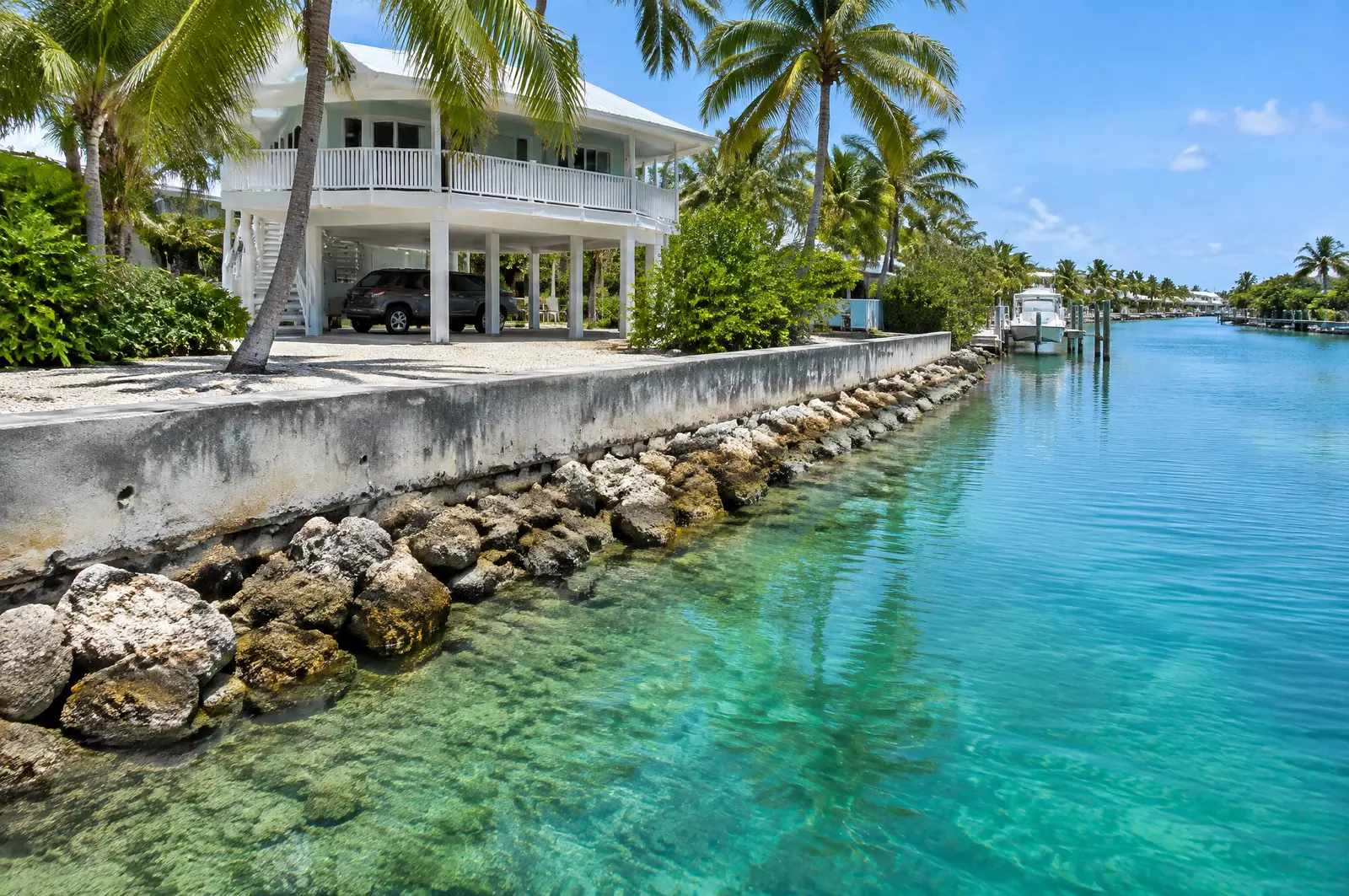
Monroe County allows vertical seawalls only to stabilise severely eroding shorelines on man-made canals, channels or basins, and never on open water. Lawfully existing walls may be repaired or replaced on the same footprint, the yard behind must sit at least 6 in below the top of the wall, and riprap goes at the toe wherever feasible.
Height is the first question on any wall job here, because it decides whether a repair can stay at the current cap or turns into a raise.[1]
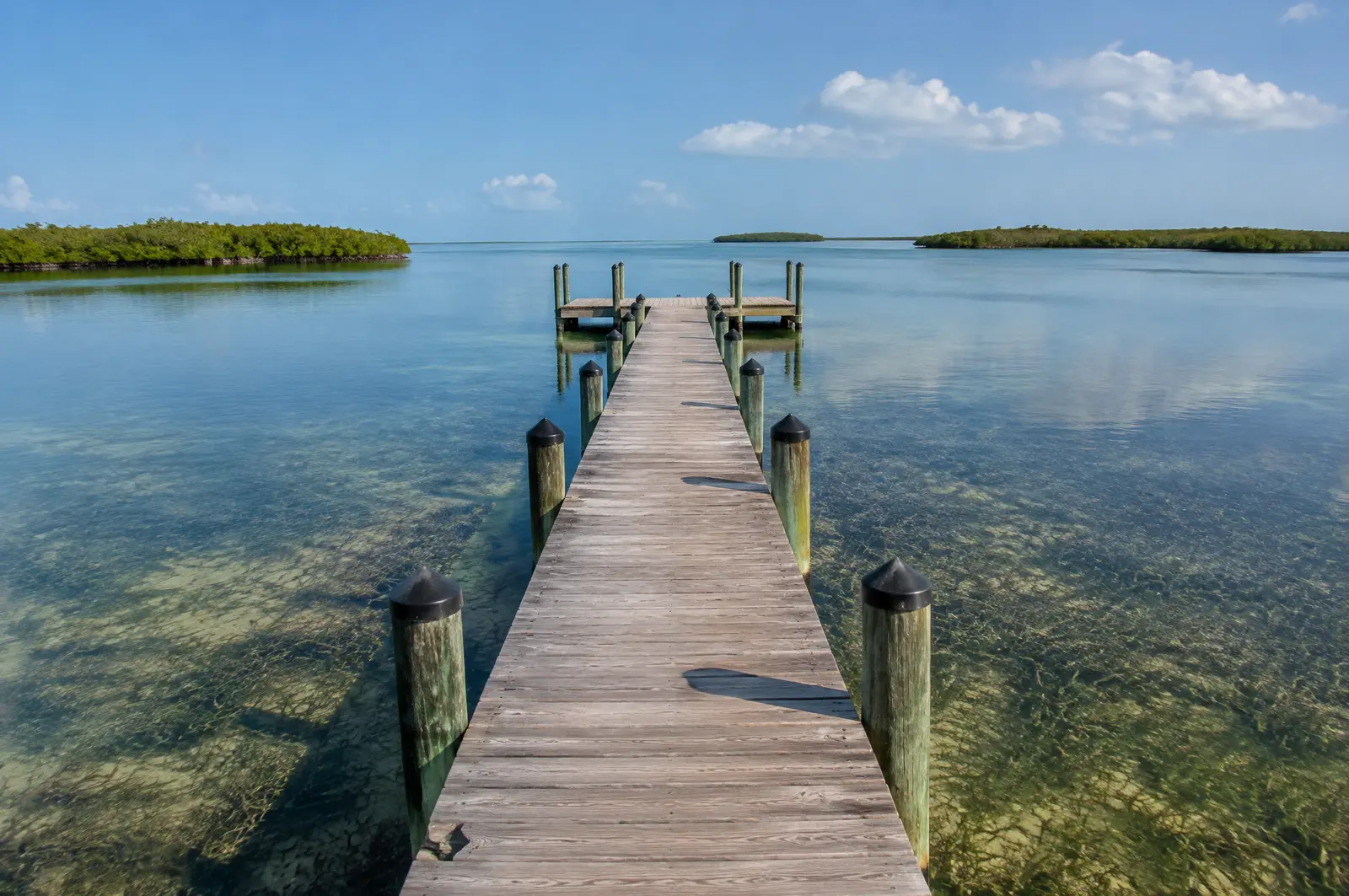
Pier docks: 4 ft wide, 100 ft long
Pier docks in unincorporated Monroe County may be no wider than 4 ft and no longer than twice the lot's shoreline frontage or 100 ft, whichever is less. Reaching deeper water takes a Dock Length Special Exception, which costs $1,450 plus $3 per shoreline owner within 300 ft.
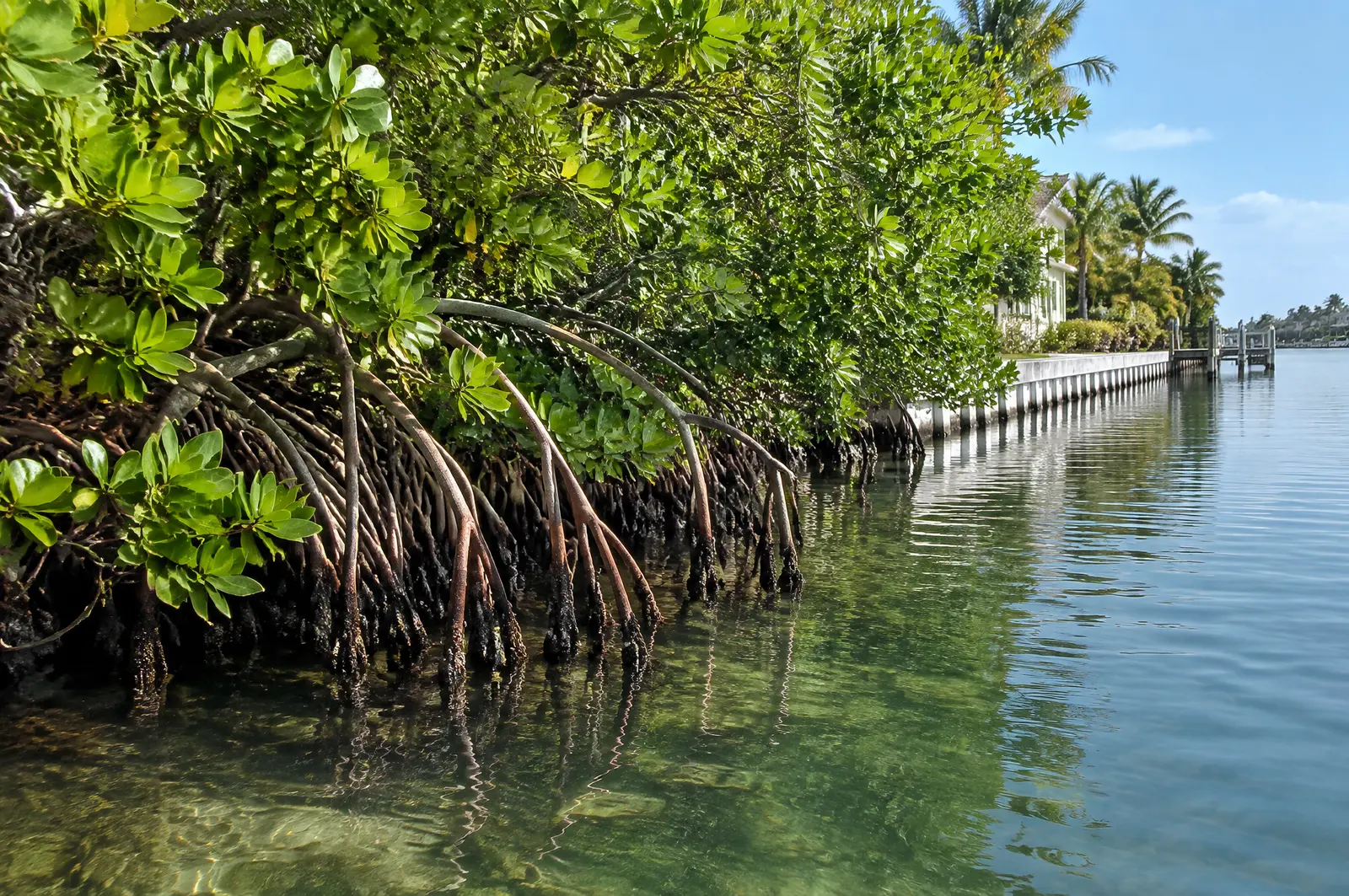
Rock is placed around existing mangroves, not over them.[1][2]
Mangrove fringes shape the design
Where a Key Largo shoreline has a mangrove fringe 10 ft wide or more, a T or L dock with a walkway perpendicular to the shore is the primary design. Riprap and walls go landward of existing mangroves wherever feasible, and a walkway through mangroves is limited to 4 ft.
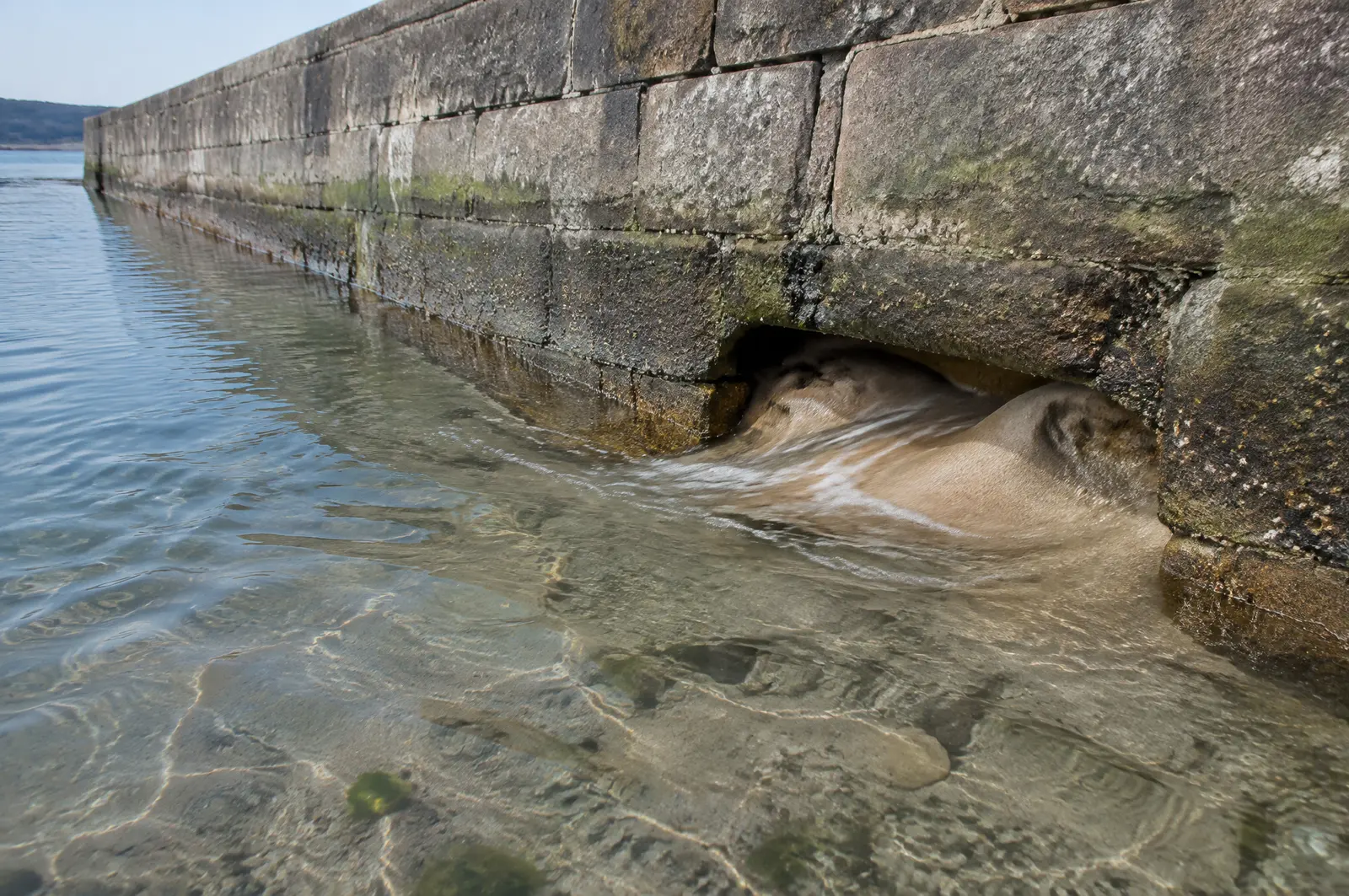
Riprap is one of the few shoreline jobs that can stay on a simpler permit when it is sized to that limit.[1]
Four feet of water, and more over grass
A Key Largo dock must end in at least 4 ft of water at mean low water. Over seagrass or hard bottom, the water must be 4 ft deep above the organisms, the deck at least 5 ft above mean high water, and the terminal platform no larger than 160 sq ft (8 by 20 ft), with a benthic survey to prove it.
Rock footprints are kept off grass beds, so a survey of the bottom comes before the rock order.[1]
What makes Key Largo different
The special exception application asks owners to describe the submerged lands the dock crosses, such as sand, seagrass or coral, and the minimum extra length needed to reach adequate water depth. The site plan must be prepared by a Florida registered architect, engineer or landscape architect and show the mean high water line and shoreline setbacks.[2]
Sanctuary, seagrass and manatees
Projects inside the Florida Keys National Marine Sanctuary needed prior Sanctuary approval under SPGP VI. The same permit let boat lifts and minor structures in Monroe County go into existing boat slips without a seagrass survey. All in-water work follows the state manatee conditions.[3][4]
Permits in Key Largo
- Monroe County Planning and Environmental Resources Department: Dock length special exceptions under County Code section 118-12(m)(15).
- Florida Keys National Marine Sanctuary: The Sanctuary starts at mean high water, so Key Largo canal and bay work is inside it; SPGP VI required its prior approval.
- Florida DEP or South Florida Water Management District: State permit or exemption, which Monroe County needs to see before it issues a Notice to Proceed for docks, seawalls and ramps.
- US Army Corps of Engineers, Jacksonville District: Federal permit, also required before the County's Notice to Proceed.
What riprap does
Riprap is a sloped layer of large rock at the base of a seawall. It breaks wave energy and stops the water from scouring sand out from under the toe. Red mangroves can grow between the rocks, which is the idea behind living shorelines.
Riprap limits and permits
Under SPGP VI, new riprap may extend no more than 10 ft waterward of the mean high water line, and repair or replacement no more than 18 inches beyond the previous footprint. Miami-Dade allows natural limerock boulder riprap on a 2:1 slope up to 10 ft waterward through an expedited authorisation after inspection.[3][6]
| Work | Rule | Fee |
|---|---|---|
| Riprap or gunite tube under undercut wall, up to 2 ft waterward | DERM exempt | None from DERM |
| Sand-cement bags at toe, up to 2 ft waterward | DERM exempt | None from DERM |
| Limerock boulder riprap, 2:1 slope, up to 10 ft waterward | DERM expedited after inspection | $170 inspection |
| Up to 100 linear ft of riprap at 2:1 or flatter | State general permit (62-330.431) | Set by FDEP |
Frequently asked questions
Can I build a new seawall in Key Largo?
Only on a man-made canal, channel or basin to stop severe erosion, and only if plants or riprap will not work. Existing lawful walls can be repaired or replaced on the same footprint.
How long can a dock be in Key Largo?
A pier dock can be no longer than twice the shoreline frontage or 100 ft, whichever is less. Longer needs a Dock Length Special Exception ($1,450 plus $3 per nearby shoreline owner).
Can I build a dock through mangroves in Key Largo?
Yes, as a T or L dock with a walkway no wider than 4 ft through an existing gap or a narrow cut, under County and state approvals.
Can I build a dock over seagrass in Key Largo?
Only if there is 4 ft of water above the grass at mean low water, the deck is at least 5 ft above mean high water and the platform is no larger than 160 sq ft, backed by a benthic survey.
Sources
- Monroe County Land Development Code, Sec. 118-12 Shoreline Setback, subsections (k) Bulkheads, seawalls and riprap and (m) Docking facilities (third-party code copy), Monroe County, Florida (text reproduced by Zoneomics; the official Municode copy blocked automated access). Accessed October 28, 2026.
- Dock Length Special Exception Application (Last revised August 2026), Monroe County Planning and Environmental Resources Department. Accessed October 27, 2026.
- Department of the Army State Programmatic General Permit VI (SPGP VI), SAJ-2015-2575, State of Florida, U.S. Army Corps of Engineers, Jacksonville District (document hosted by Florida DEP). Accessed October 27, 2026.
- Standard Manatee Conditions for In-Water Work (2011), Florida Fish and Wildlife Conservation Commission (FWC). Accessed October 27, 2026.
- Community Rating System (CRS), Monroe County, Florida. Accessed October 28, 2026.
- Class I Permit Application for Coastal Construction and Mangrove Trimming within Miami-Dade County (Revised May 2025), Miami-Dade County RER, Division of Environmental Resources Management (DERM), Coastal Resources Section. Accessed October 27, 2026.
Get a free quote
Tell us about your project and we will get back to you fast.